The Signal / Field notes 002 / October 4, 2026
The UAD 3.6 transition
The clock split in two.
November 2 still starts the mandate. A temporary exception gives some lenders more time to use UAD 2.6. March changes the consequences of staying on that route.
Inside: six industry responsesA date can stay in the rulebook while the path to complying with it changes.
On September 30, Fannie Mae and Freddie Mac offered a temporary policy exception to sellers unable to complete their UAD 3.6 implementation by November 2. The mandate itself remains. A seller that obtains the exception can submit new UAD 2.6 appraisal reports through May 19, 2027 while carrying out an agreed implementation plan. Joint GSE announcement ↗
That creates a mixed-format period, rather than a single nationwide switch. A lender ready for 3.6 may continue ordering it. A seller with an approved exception may order 2.6 for longer. An appraiser cannot choose the exception for a client. The format still needs to be confirmed in the assignment instructions.
The control point
The exception sits with the seller.
Only a Fannie Mae- or Freddie Mac-approved seller requests the exception, and it must apply to each GSE to which it sells loans. An aggregator buying from third-party originators must either ensure those partners submit 3.6 or obtain the exception. A lender that does not sell directly to the GSEs does not request one from them; it coordinates its format plan with its investor. Joint announcement, policy compliance ↗
The lender can use the redesigned Uniform Residential Appraisal Report and submit it through UCDP.
The seller can continue using the legacy format through May 19 while it completes its implementation plan.
The client's order controls what report to prepare. A seller's exception does not automatically make every client accept 2.6.
Fannie Mae tells appraisers that the exception may affect the format a lender requests, while their responsibility to adopt UAD 3.6 continues. Fannie Mae appraiser guidance ↗
Transition map
Four turns in the road.
The distinction is easiest to see in sequence. The relevant event is the initial submission of the appraisal to the Uniform Collateral Data Portal (UCDP), not the date the appraisal was ordered or the property's effective date. Updated GSE FAQ ↗
- 01Nov 022026
Mandate begins
New submissions must use UAD 3.6 unless the seller has the applicable GSE exception.
- 02Mar 012027
Legacy route narrows
Approved sellers may still submit 2.6, with reduced collateral-review functionality and no value-related R&W relief on those loans.
- 03May 202027
New reports: 3.6 only
The exception period ends after May 19. New 2.6 submissions receive a fatal UCDP message.
- 04Jun 282027
2.6 retires
The last window for resubmitting an earlier 2.6 report closes June 27.
Previously submitted UAD 2.6 appraisals have a separate revision window through June 27. The updated joint timeline replaces earlier materials that showed a May 3 retirement date. Current joint timeline ↗
March 1 – May 19, 2027
Permitted does not mean equivalent.
Approved sellers can still submit new UAD 2.6 appraisals during this period. The collateral-review output changes, and loans secured by those reports lose eligibility for collateral representation and warranty relief for value.
This is a business consequence for the seller, not a ban on every legacy report. The GSEs explicitly urge sellers to move to 3.6 before March 1. Joint announcement ↗
These specified output codes signal reduced functionality for 2.6 submissions in this period. They should not be read as comparable numeric risk estimates. Fannie Mae lender letter ↗
A system-wide change
A report is only ready when the whole path is ready.
UAD 3.6 changes the report, the data file, software integrations, ordering, review, and loan delivery. The GSEs' lender readiness materials ask firms to verify that appraisers and AMCs can produce the report and that technology partners can order, receive, review, consume, and submit it. A working form on one desktop is one piece of that chain. GSE readiness questionnaire ↗
The GSE announcement says some lenders need more time; it does not publish a count of approved exceptions or assign a single cause. Industry evidence helps describe the friction, but it cannot prove why a particular seller needs an exception.
863 appraisers responded. The figures below use the answer count for each question.
These are self-reports from one vendor's network, not measured national performance. Expectations about time and fees should be checked against actual assignments. CSS survey and methodology ↗
Appraiser discussion excerpts reviewed by The Signal describe software bugs, orders that mix legacy form names with 3.6 instructions, and uncertainty about whether lenders will use the exception. They also include accounts of appraisers becoming faster after practice. These are individual experiences, not a representative survey; we do not identify members of private discussions.
The National Association of REALTORS® calls the change an effective delay, while the GSEs keep the formal November mandate. Both descriptions point to the same practical fact: different lenders can be on different implementation schedules. NAR's September 30 response ↗
The reaction
One exception. Six readings.
The policy is precise. Its effect on daily work is still being debated. These public LinkedIn responses show the range: firms already delivering 3.6, leaders worried about readiness, and educators asking where the transition is getting stuck.
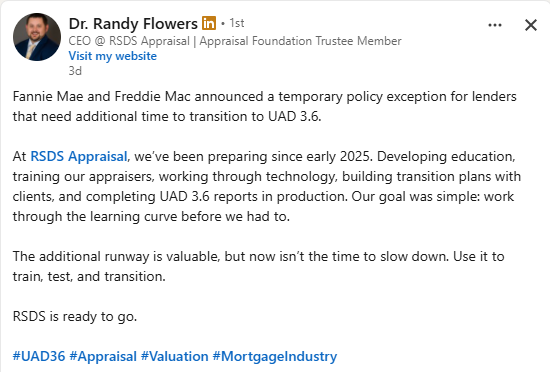
Dr. Randy Flowers
CEO, RSDS Appraisal
RSDS says it began preparing in early 2025, trained appraisers, built client transition plans, and has completed 3.6 reports in production. Flowers calls the extra runway valuable but says, “Use it to train, test, and transition.”
The exception need not slow a firm that is ready.
View post screenshot ↗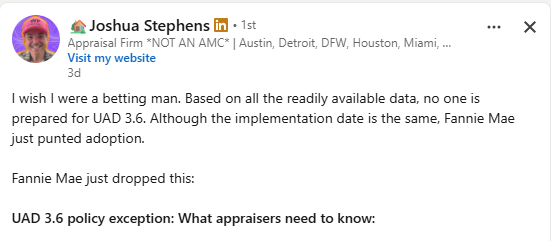
Joshua Stephens
WP Appraisers
Stephens argues that the industry is not ready for UAD 3.6 and describes the exception as a punt, despite the unchanged November date. That is his assessment of readiness, not a finding in the GSE announcement.
A fixed mandate can still feel delayed in practice.
View post screenshot ↗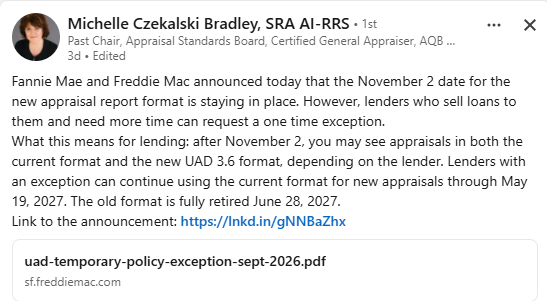
Michelle Czekalski Bradley
SRA, AI-RRS · appraisal standards leader
Bradley stresses that November 2 remains the mandate while a lender-specific, one-time exception may keep both report formats in circulation. Her reading tracks the joint GSE timeline: new legacy submissions end May 19; resubmissions end June 27.
Ask which path the client is actually using.
View post screenshot ↗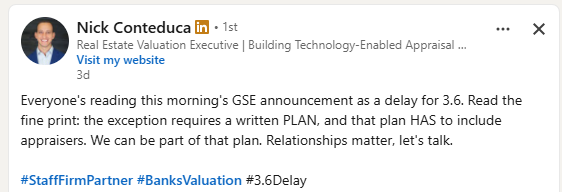
Nick Conteduca
Chief Strategy Officer, Banks Valuation
Conteduca draws attention to the written implementation plan required for an exception. His emphasis is practical: lenders need to talk with the appraisers and firms who will carry out the transition, not only submit a request.
The policy window creates a coordination job.
View post screenshot ↗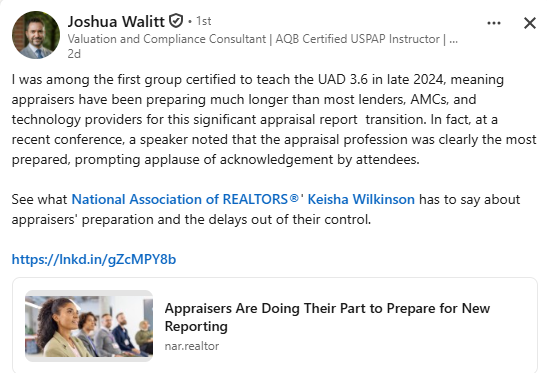
Joshua Walitt
Principal, Walitt Solutions
Walitt pushes back on treating appraisers as the sole bottleneck. He says UAD 3.6 instructors were certified in late 2024 and many appraisers prepared while lenders, AMCs, and technology partners were still working through their own changes.
A report can be ready before the delivery chain is.
View post screenshot ↗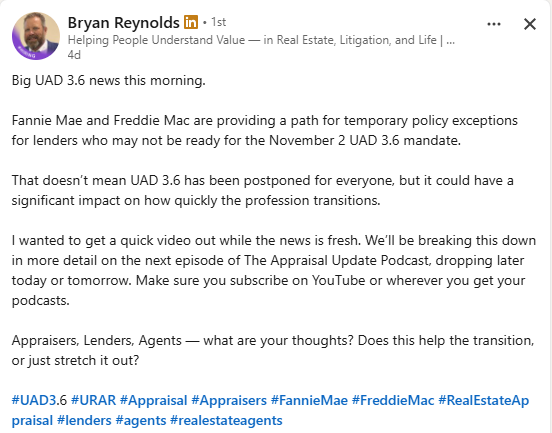
Bryan Reynolds
Legacy Appraisal and Consulting
Reynolds points to the second-order effect: a policy exception may change the pace of adoption, even though it does not postpone 3.6 for everyone. His question is whether the runway helps the industry transition or simply stretches it.
More time is useful only if the work continues.
View post screenshot ↗These are individual responses, not a poll or official guidance. We summarized the posts shown in the linked screenshots; the GSE documents above govern the policy dates and conditions.
Field guide
Get the format in writing.
The exception is a seller-level policy decision. The appraiser's immediate risk is an ambiguous order. Resolve these points with the client before committing a fee and due date.
- 01
Which report format is required?
Confirm UAD 3.6 or UAD 2.6 explicitly. A legacy form number in an order does not settle an instruction elsewhere calling for 3.6.
- 02
Who will submit it, and when?
The initial UCDP submission date controls the mandate. The client's planned submission date matters more than the order date. GSE FAQ ↗
- 03
If 2.6 is requested after November 1, what is the client's path?
Ask the client to confirm its applicable exception or investor instructions. Appraisers do not file the seller's request.
- 04
What work and review cycle are expected?
Price and schedule the assignment for the specified format, software workflow, inspection scope, and likely review process.
The extra runway is real, but it belongs to a transition plan. November 2 starts the mandate; March 1 weakens the legacy route; May 20 closes it for new submissions. The most useful next step is a clear conversation between the appraiser and the client about the format required for the actual assignment.
Sources checked October 4, 2026. This article summarizes GSE policy and industry evidence; lenders should follow their applicable selling guides and written exception terms. The informal discussion excerpts informed reporting questions and are not quoted or treated as survey data.
The Signal / Monthly briefing
Follow the transition as it happens.
One sourced briefing in the first week of each month.
Unsubscribe in one click. We don't sell your email or share it with sponsors. Privacy Policy