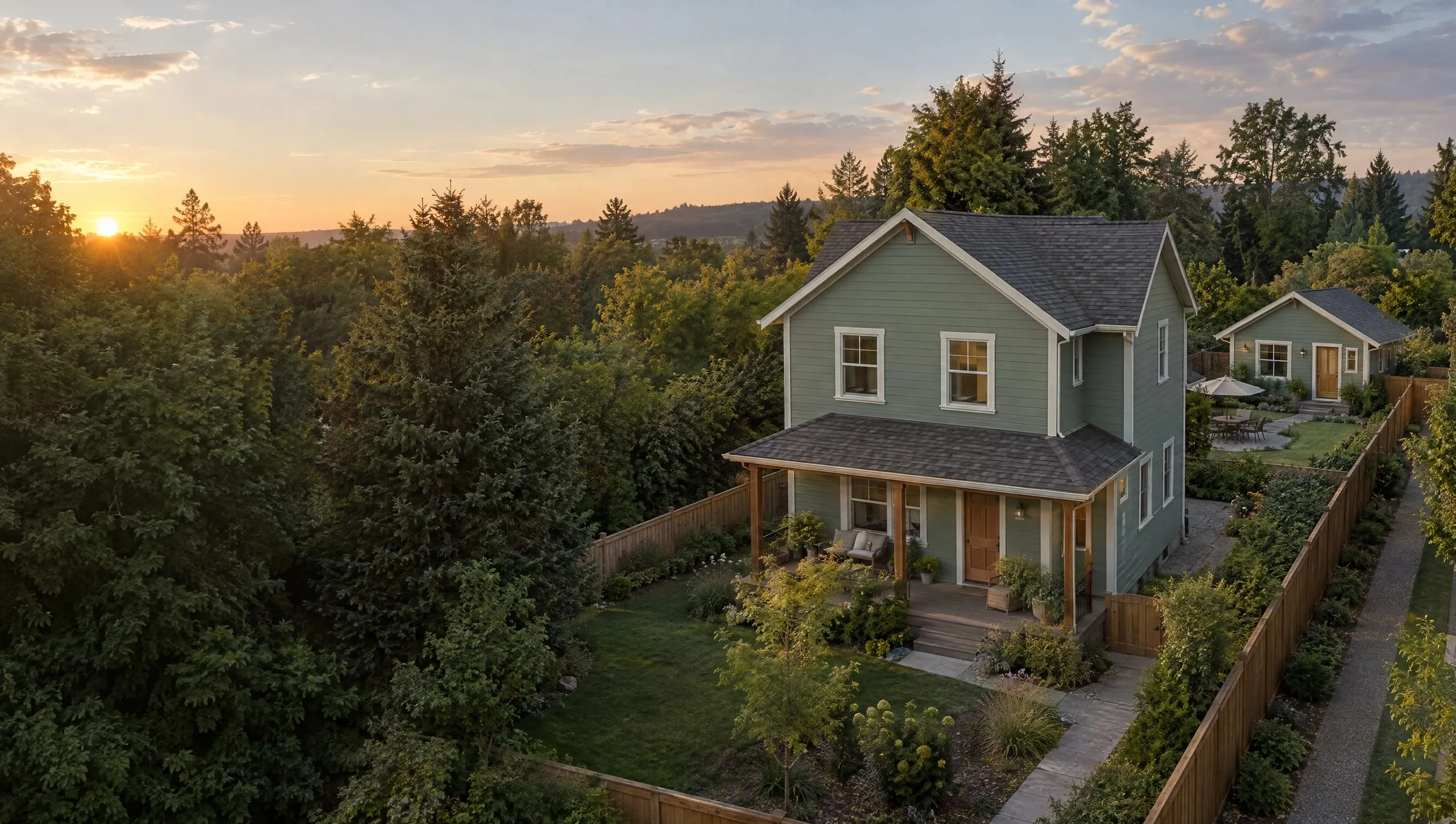
The Signal / UAD 3.6 / October 11, 2026
The backyard housing shiftADUs, lending and the UAD 3.6 opportunity
An accessory dwelling unit puts a second home on a parcel that already has one. UAD 3.6 reports that unit in its own fields, and since March 31, 2026 Fannie Mae has financed some configurations with up to three ADUs, on loans with UAD 3.6 appraisals only. This feature covers both changes, along with demand, financing, valuation and selected state laws.
A small building behind a house can serve several purposes over its life: a home for a parent, a rental for a teacher, or space for an adult child starting out. For a lender it raises four questions. Is it a separate dwelling? Can it legally be rented? What does the market pay for it? Does the loan program accept the configuration?
Accessory dwelling units, usually called ADUs, add a place to live on land that already has a home.
This feature centers on two 2026 changes. UAD 3.6 gives reviewers more consistent information about each unit on a parcel. Fannie Mae has opened financing paths for some configurations with more than one ADU, and those paths apply only to loans with UAD 3.6 appraisals.123
Three questions this article returns to
- 01What exists on the property?Structures, units, facilities
- 02What can legally happen there?Zoning, permits, rental rights
- 03What evidence supports its value and income?Sales, rents, program rules
Six physical forms, one test: independent living facilities on the same parcel
In Fannie Mae’s property guidance, an ADU has independent facilities for living, sleeping, cooking and bathing, on the same parcel as the primary dwelling. Separate access and privacy matter. A second kitchen alone does not make a space an ADU, and the name used in a listing does not decide the classification.4
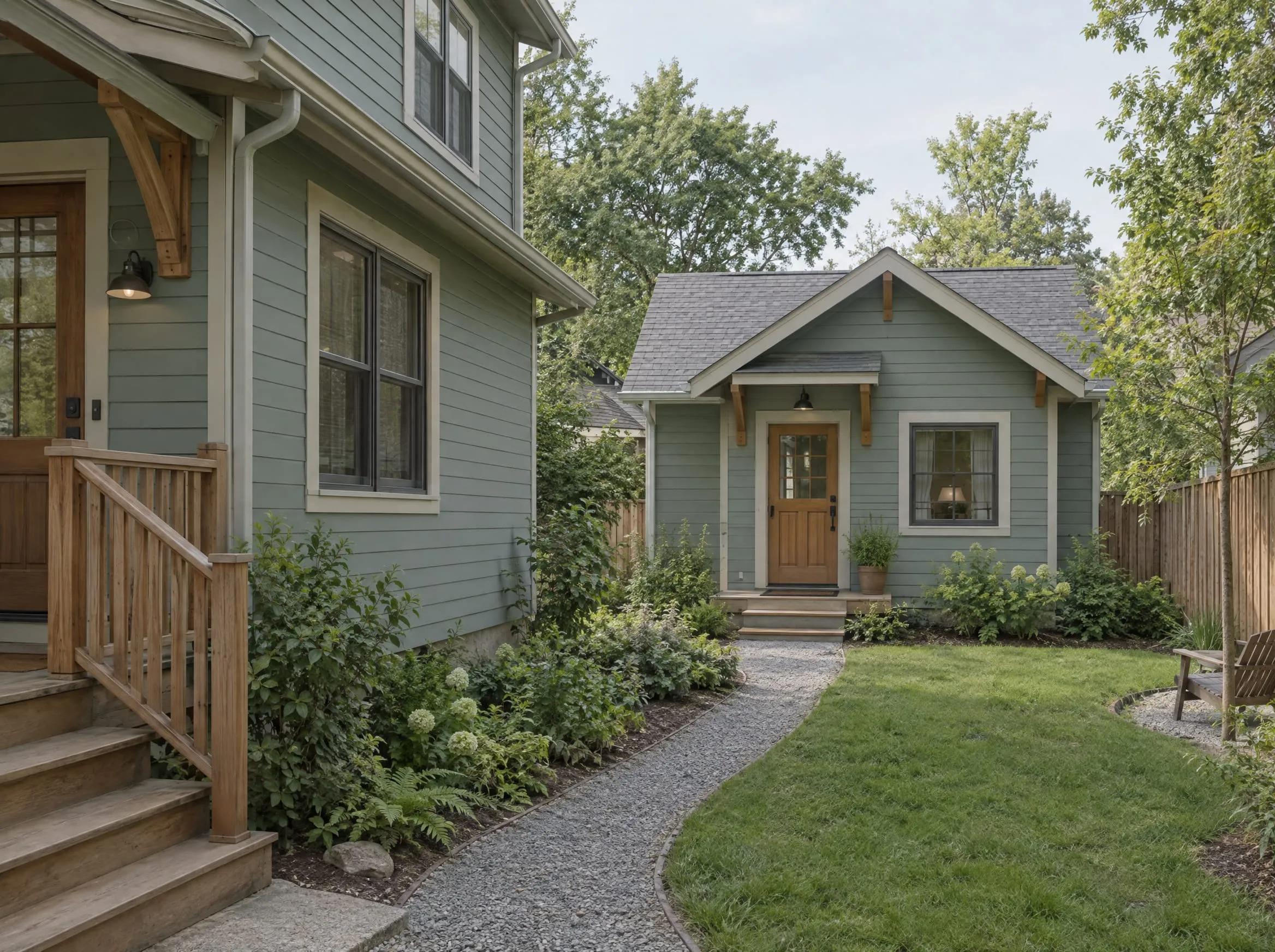
Detached cottage
A separate backyard residence
Questions for collateral review
Access, utility connections, site fit and independent living facilities
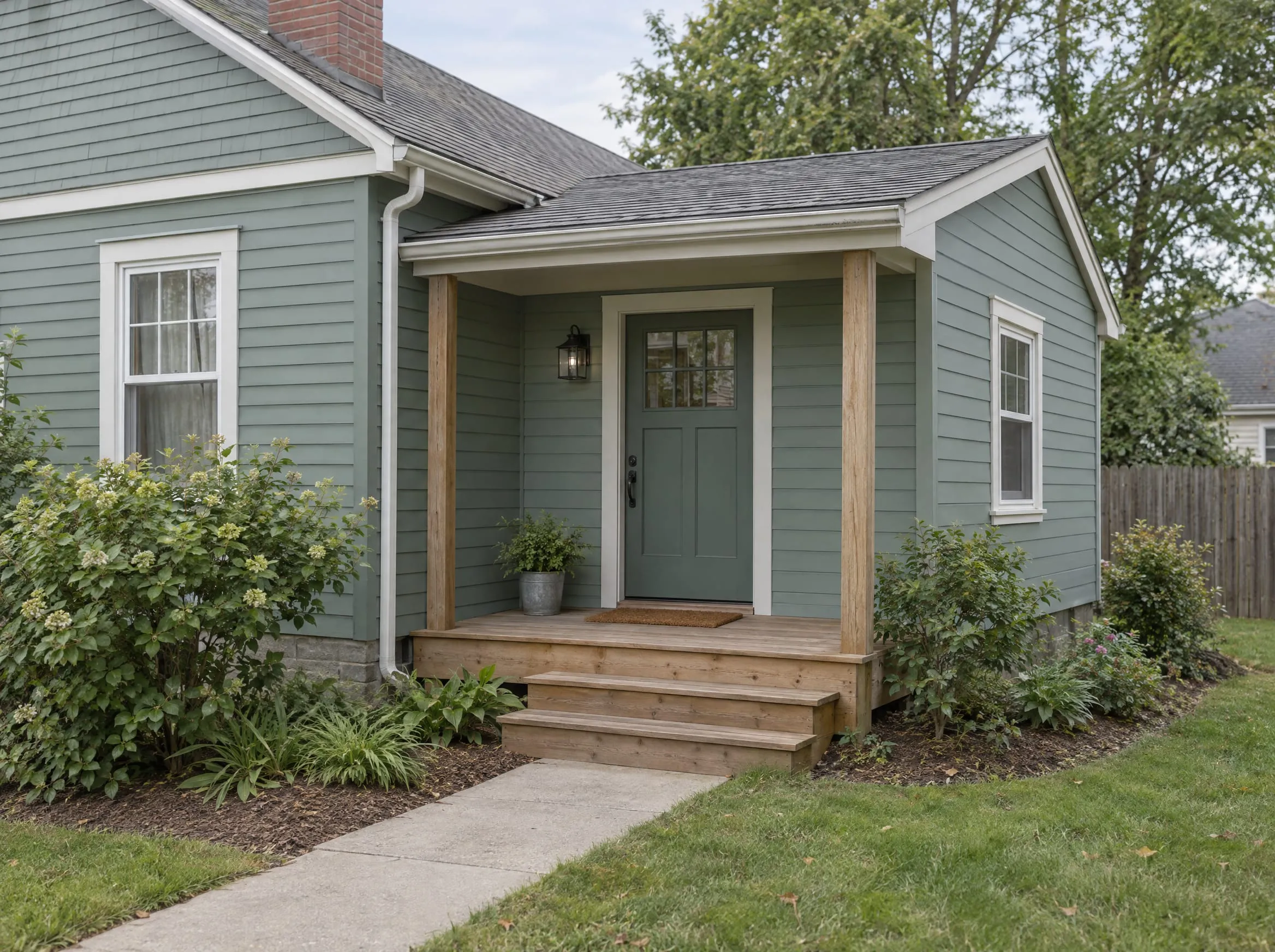
Attached addition
A residence added to the side or rear of a house
Questions for collateral review
Separation, entrance, layout and integration with the main dwelling
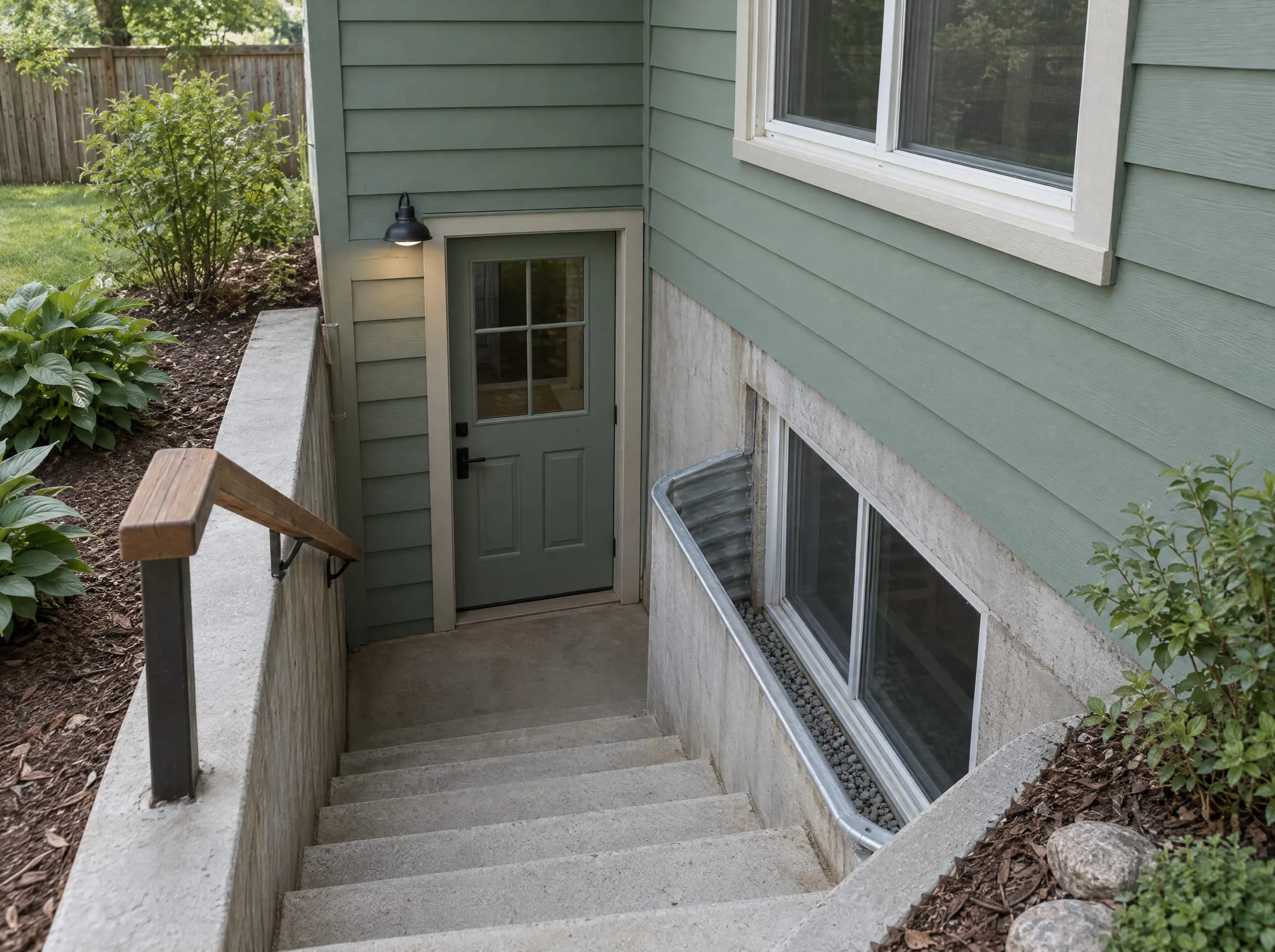
Interior conversion
A basement or other part of the home made into an independent unit
Questions for collateral review
Grade, ceiling height, egress and privacy
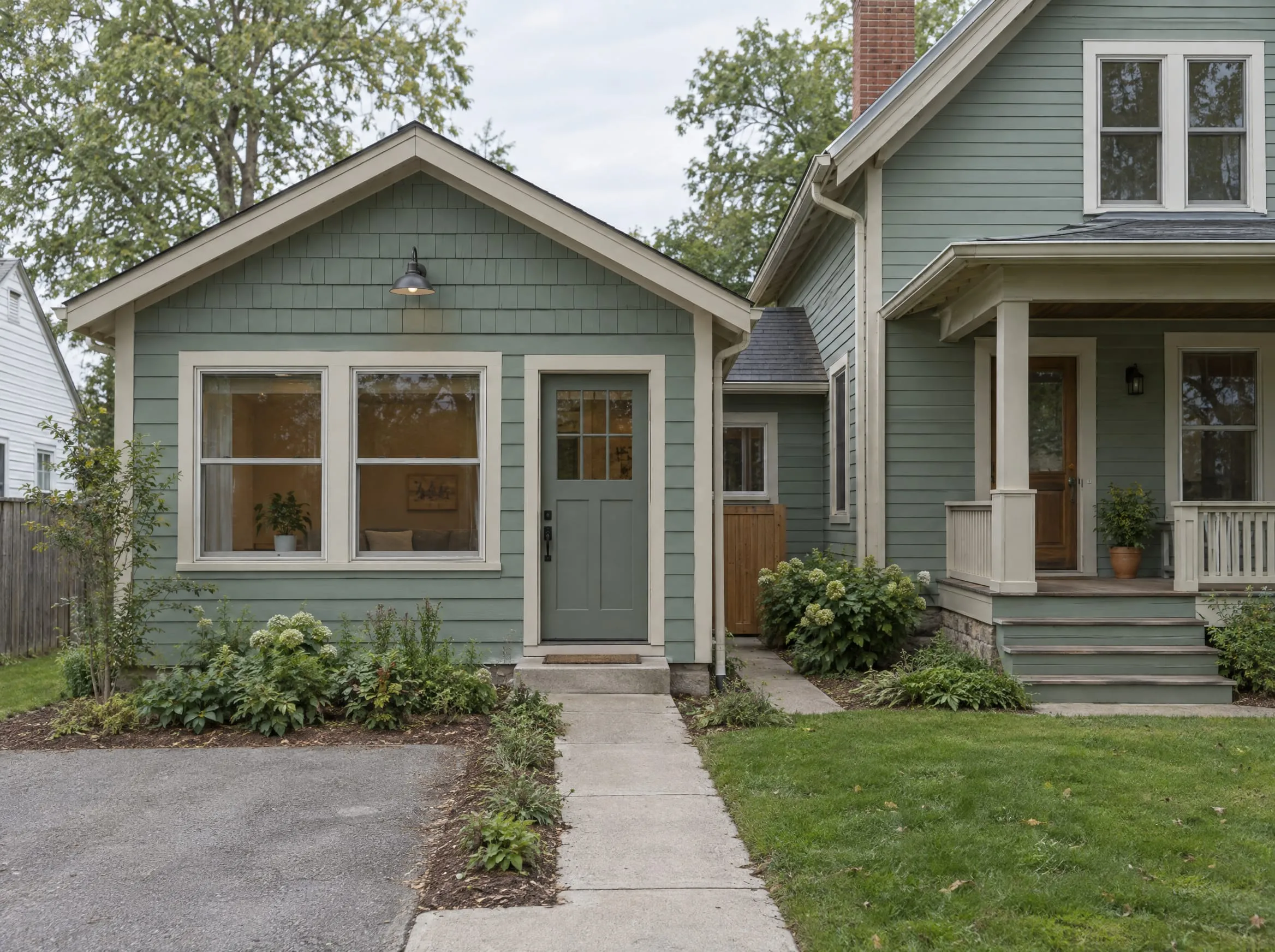
Garage conversion
Living facilities within a former garage
Questions for collateral review
Permits, construction quality, drainage and utility service
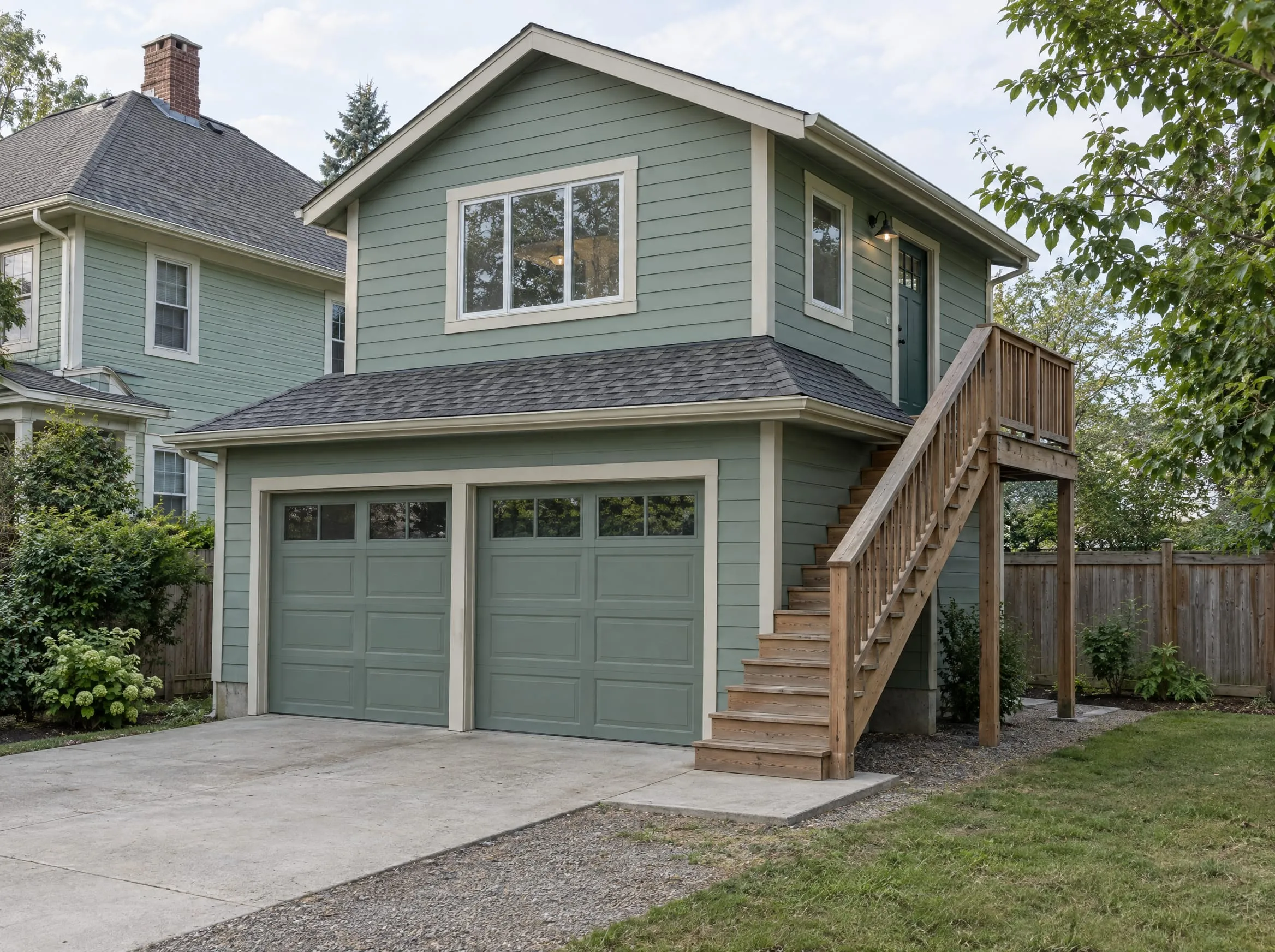
Above-garage unit
A residence over vehicle storage
Questions for collateral review
Stair access, separate measurement and the relationship to the garage
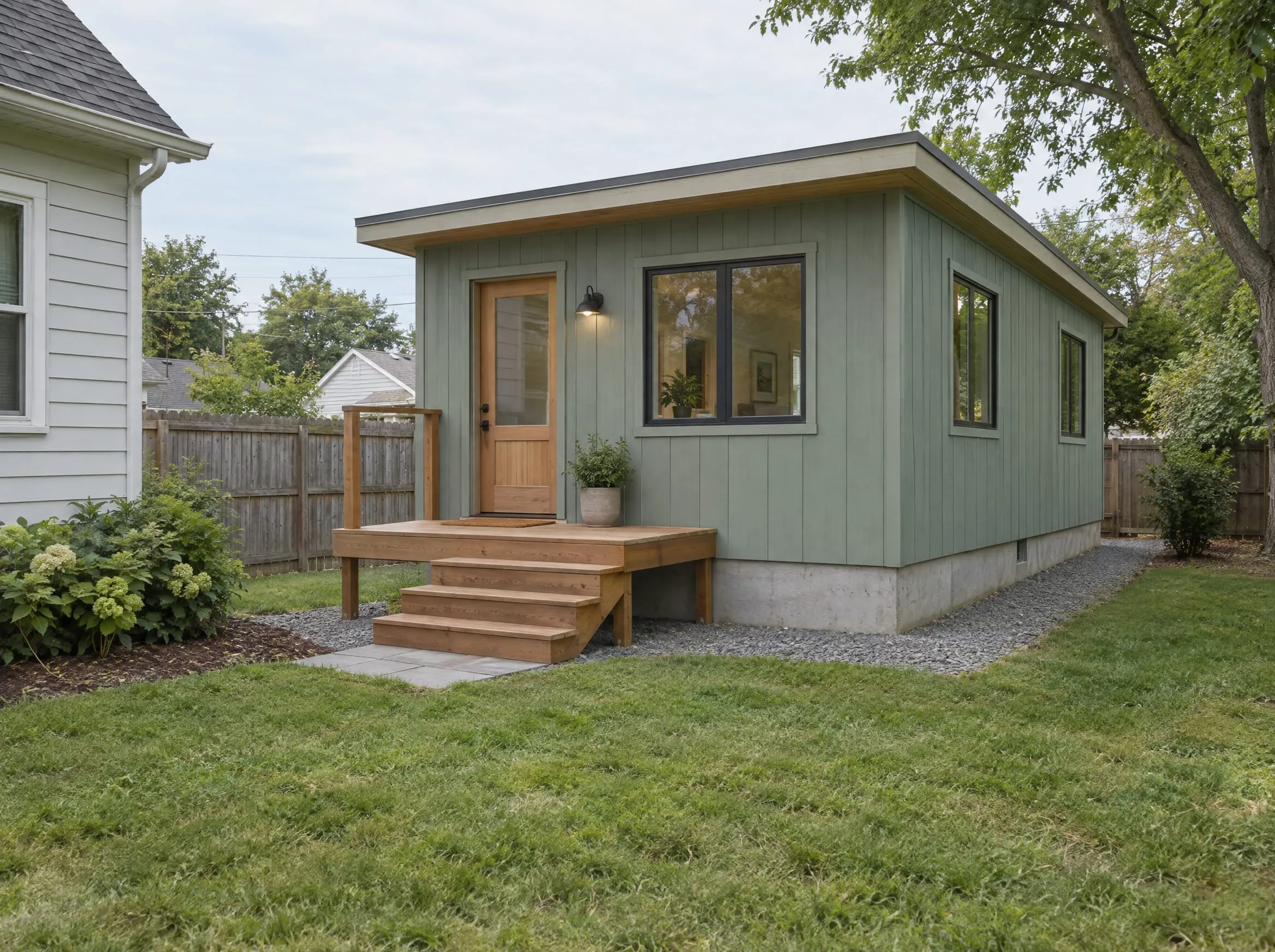
Factory-built ADU
A unit delivered partly or largely assembled
Questions for collateral review
Construction code, foundation, ownership status, installation and lien coverage
AI-generated architectural illustrations of each form. They do not show real properties and do not establish permits or loan eligibility.
State housing guidance and GSE resources recognize all six forms. Factory-built is a construction category: modular construction and HUD Code manufactured housing have different requirements, and a tiny home on wheels needs its own legal and collateral analysis.56
California also recognizes a junior ADU, or JADU, with no more than 500 square feet of interior livable space. A JADU can share sanitation facilities with the main home, so test it against the selected mortgage program’s independent-living requirements.7
Guest houses and ADUs
In the UAD 3.6 reference guide, a guest house is an outbuilding that provides temporary living quarters and does not have all the elements of a dwelling unit. A detached room with a bathroom can have real market value and still be classified differently from a full ADU. A structure that an MLS listing calls a guest house may have complete independent living facilities, so check the facilities before accepting the label.8
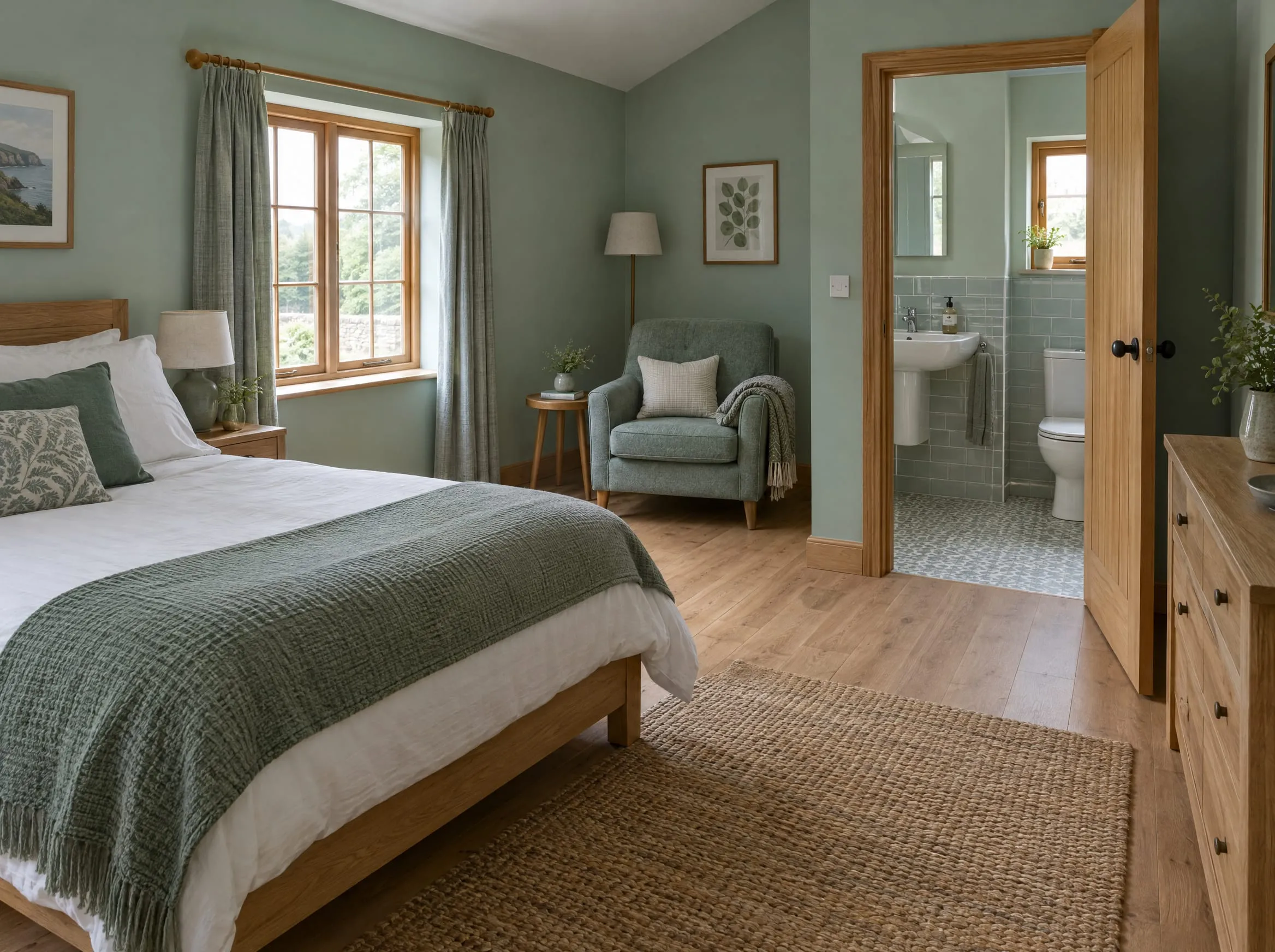
Guest house Bathroom, sleeping area, no cooking facilities
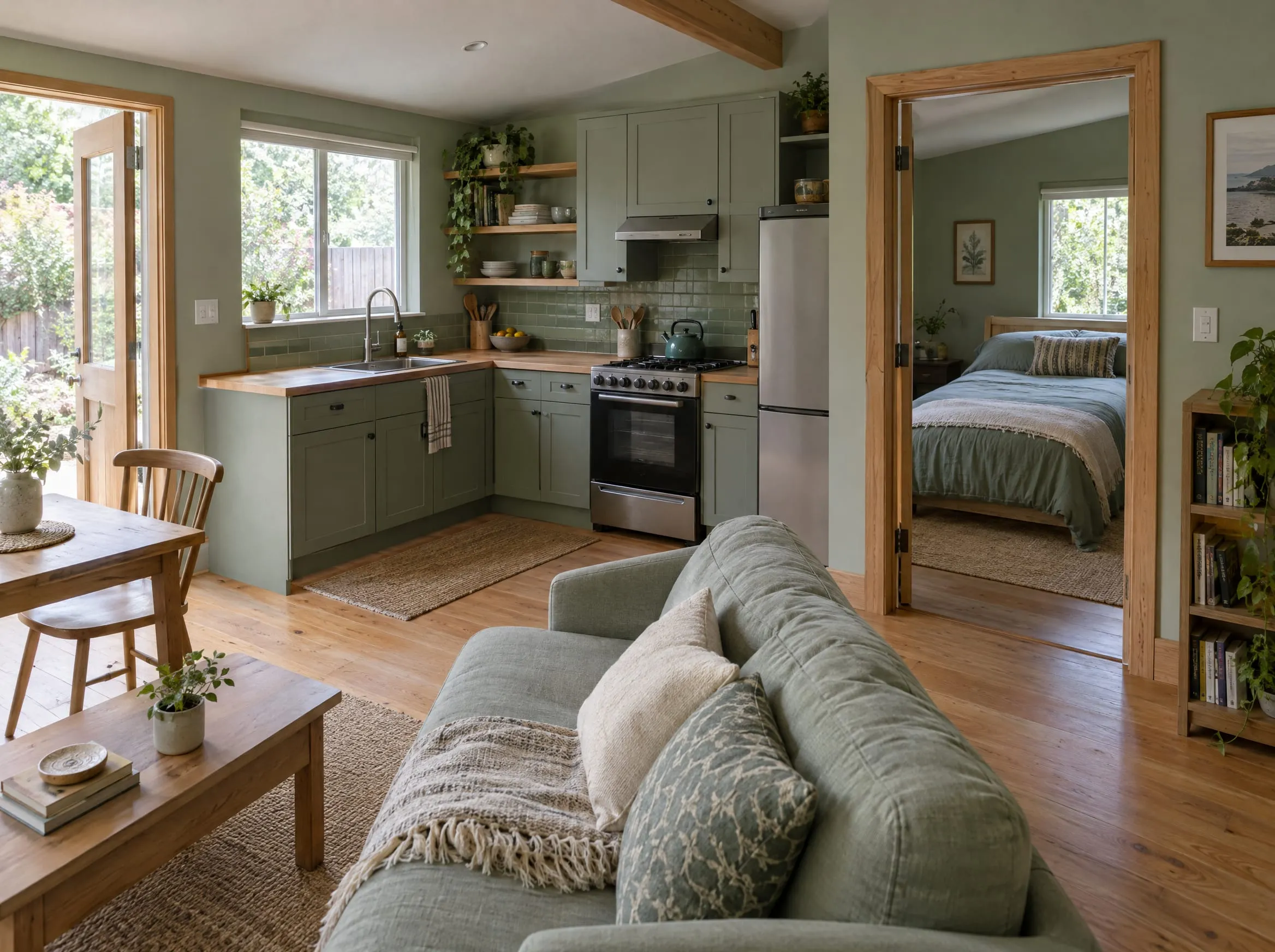
ADU Living, sleeping, cooking and bathing facilities
A 450-square-foot guest house used by visiting family might appeal strongly to buyers. An income estimate would still need evidence of lawful rental use and appropriate rent comparables, and naming the structure does not create those rights.
Four measures of ADU demand, each with its own denominator
Freddie Mac’s 2020 research identified 1.4 million distinct single-family properties with ADUs by text-mining historical MLS descriptions. The share of homes sold in its MLS dataset with an ADU rose from 1.1% in 2000 to 4.2% in 2019, and about half of the identified properties were in California, Florida, Texas and Georgia. This is historical listing evidence with coverage and classification limits, and it does not count current inventory.9
Source: Freddie Mac, July 2020.9 Text identification can include legal and illegal units and misses activity off the MLS. This is not a count of current national stock.
Data table
| Year | Share |
|---|---|
| 2000 | 1.1% |
| 2019 | 4.2% |
Freddie Mac also measured stated interest. In a survey of 2,500 people fielded November 8 to 10, 2022 and published in January 2023, it found that 71% were unfamiliar with ADUs. After hearing a definition, 32% of respondents without an ADU said they were interested in having one. Interest is a signal; building a unit also takes a feasible site and funding.10
Source: Freddie Mac, January 2023.10 Each percentage is of the interested respondents, not of all 2,500.
Data table
| Reason | Percent |
|---|---|
| Hosting out-of-town visitors | 37% |
| Renting to tenants | 33% |
| Renting to vacationers | 21% |
| Family living there permanently, paying rent | 19% |
| Family living there temporarily, without rent | 18% |
California’s Department of Finance reports 29,710 ADU additions to the housing stock during 2025, up 11.42% from the year before. In the same release, 17,694 newly constructed ADUs made up 15.2% of all new construction. These are different measures. Conversions are one reason stock additions and new-construction counts need separate treatment, and the release’s headline bullets do not reconcile the two.11
Massachusetts gives a newer adoption signal. Its Aug. 12, 2026 announcement reported 854 ADU approvals in the first six months of 2026, bringing approvals since the start of 2025 to 2,084. Approvals show a development pipeline and are separate from completed, occupied homes.12
- 202529,710ADUs
California ADU additions to the housing stock
Up 11.42% from 202411
- 202517,694ADUs
California newly constructed ADUs
15.2% of all new construction11
- January to June 2026854approvals
Massachusetts ADU approvals
Approvals, not completed homes12
- Reported Aug. 12, 20262,084approvals
Massachusetts ADU approvals since the start of 2025
Cumulative, includes the 85412
Four separate measures. They cannot be ranked against each other, and the California pair should not be subtracted to estimate conversions.
How the new report describes an ADU, and what Fannie Mae now finances
What legacy reports already required
Legacy appraisal guidance already asked appraisers to describe an ADU and analyze its effect on value and marketability. It also distinguished ancillary structures and required separate treatment of certain areas.13
A careful UAD 2.6 report could therefore give a strong ADU analysis. The practical difficulty was where the information sat: in descriptions, extra grid lines, sketches, photos and narrative addenda. Two appraisers could document similar properties in ways that were hard to compare. We found no nationwide audit that quantifies deficient ADU reporting under UAD 2.6.
Take an illustrative report that says “guest quarters: 600 sf” and carries a $75,000 adjustment. The reviewer has to find out what is inside the structure, whether it can be rented and which evidence supports the adjustment. An addendum may answer every question. When it does not, the lender needs a revision, a deeper review or a different financing path. The example illustrates review friction; the sources reviewed contain no measured national rejection rate.
The GSEs’ UAD 3.6 FAQs say the redesigned report presents ADU size, condition, rooms and location more consistently, which makes them easier for reviewers to identify.2
Make the second home visible
One fictional parcel for every step: a 2,000 sq ft main house, a 600 sq ft detached ADU, and a 450 sq ft guest house with a bathroom and no kitchen. All dimensions and labels are an illustrative example. This is a teaching interface and does not reproduce a GSE form.
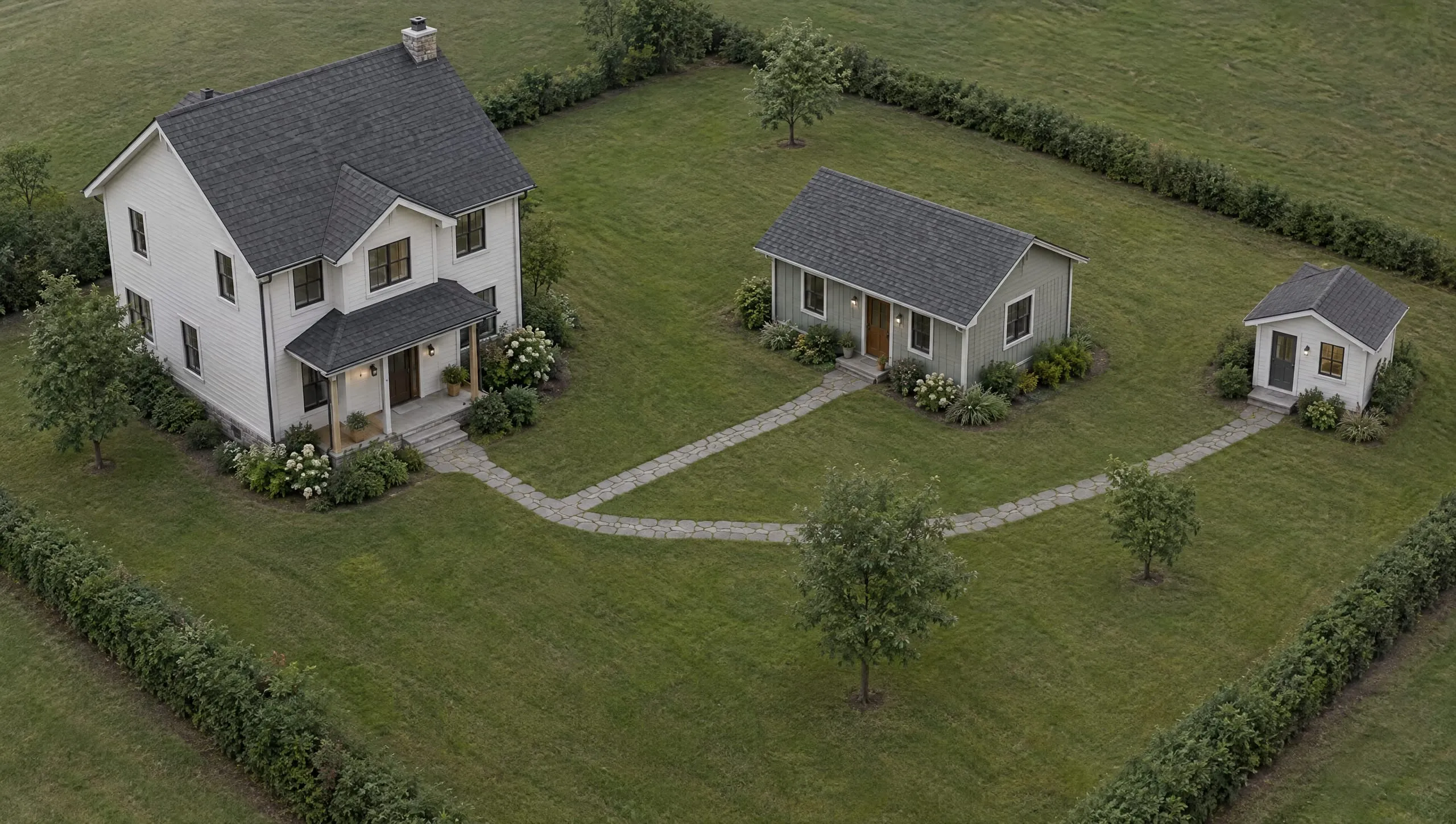
- 01 / The parcel
Three structures share one lot. Before a reviewer can classify anything, each structure has to be identified.
- 02 / A sparse legacy summary
In this made-up legacy summary, the ADU and the guest house exist on the ground but appear only as a phrase in an addendum.
Legacy summary, illustrativeMain dwelling: 2,000 sf. Guest quarters mentioned in addendum.
Sparse example created for explanation; legacy reports could include full analysis. - 03 / One record per unit
Under UAD 3.6, each unit gets its own record. An ADU gets a separate Unit Interior section, and the report counts units other than ADUs separately from ADUs.1415
Unit recordMain dwelling2,000 sq ft. Primary unit.
Unit recordADU600 sq ft. Detached.
OutbuildingGuest house450 sq ft. Bathroom only.
- 04 / The ADU record
The ADU record carries its own facts: facilities, separate area, a legal rentability answer with its data source, market typicality, ingress and egress, any separate postal address, and a unit-to-unit rent comparison.14
- Facilities
- Kitchen, bathroom, sleeping and living areas, separate entrance
- Separate area
- 600 sq ft, outside the main dwelling’s area
- Legally rentable
- Answered, with its data source (illustrative: permit and zoning letter on file)
- Rent analysis
- Unit-to-unit rental comparison
- 05 / The guest house record
The guest house has a bathroom and no kitchen, so in this example it is an outbuilding, and the ADU count stays at one. It can still add value as an amenity, but it supports no ADU rental income.8
- Facilities
- Bathroom and sleeping area, no kitchen
- Classification
- Guest house outbuilding; the ADU count stays at one
- Value treatment
- Ancillary amenity, supported by market evidence
- 06 / Three separate conclusions
The reviewer reaches three conclusions, each on its own evidence: what each structure is, what the market pays for it and where each adjustment sits, and whether the selected program accepts this configuration and this income.
- ClassificationWhat is each structure?
- Value supportWhat does the market pay, and what does each adjustment capture?
- Program eligibilityDoes the program accept this configuration and this income?
What becomes more visible
The inspection and reporting tips call for a separate Unit Interior section for an ADU. It records separate areas and ADU-specific information, including legal rentability and its data source, market typicality, ingress and egress, and a separate postal address. Rental reporting also moves toward unit-to-unit comparisons.14
| Review question | Legacy report: where a reviewer might look | UAD 3.6: clearer reporting structure |
|---|---|---|
| How many units are on the parcel? | Property description and addenda | Separate counts for units other than ADUs and for ADUs15 |
| Is this living area an ADU? | Narrative and improvement descriptions | ADU identification tied to the individual unit8 |
| Can it be rented legally? | Zoning discussion and supporting documents | An explicit legal rentability answer and its data source14 |
| How much area belongs to the ADU? | Grid entries and sketches | Separate unit areas and an identifiable unit record14 |
| What is its condition? | Property ratings and narrative | More consistent ADU condition reporting2 |
| What rent is being compared? | Attached rent schedule and commentary | A unit-to-unit rental comparison14 |
| How are different unit counts adjusted? | Extra grid lines and explanations | An identified total-unit row and feature-level guidance2 |
These are reporting improvements. Their value for lending is a reasoned inference: consistent fields can make classification conflicts easier to detect, let reviewers ask more precise questions and support more comparable portfolio data. A field marked “legally rentable” still needs a sound source, and an XML file that passes validation still needs a credible valuation.
What Fannie Mae now allows under UAD 3.6
Fannie Mae announced expanded ADU property eligibility effective March 31, 2026, specifically for loans with UAD 3.6 appraisals.3 The September 2026 supplement sets the current limits for properties other than manufactured homes:
| Principal residence configuration | Maximum ADUs | Total units at that maximum |
|---|---|---|
| One-unit principal residence | 3 | 4 |
| Two-unit principal residence | 2 | 4 |
| Three-unit principal residence | 1 | 4 |
| Four-unit dwelling | 0 | 4 |
Source: Fannie Mae Selling Guide Supplement, UAD 3.6 Policy, SB2-3-04.1
The same table excludes ADUs on mixed-use properties, second homes and investment properties. Manufactured homes have separate, additional rules. ADUs remain subordinate in size and subject to other requirements, so read the occupancy and construction categories together with the unit count.1
Under Fannie Mae’s legacy property eligibility section, the comparable starting point is one ADU with a one-unit primary dwelling; ADUs with two- to four-unit dwellings are excluded.4
For the principal-residence configurations it covers, this is a real expansion of financing access. A house with two qualifying ADUs fits an express UAD 3.6 path that the legacy eligibility table does not provide, and so does a duplex with a qualifying ADU. The appraiser still has to classify the property correctly and establish market support, and the other lending requirements still apply.
Freddie Mac’s February 2026 fact sheet uses a different framework: one ADU on a one-, two- or three-unit property, under its own conditions. Fannie Mae’s three-ADU allowance does not carry over to Freddie Mac.6
Configuration explorer
Fannie Mae ADU count limits for principal residences, simplified
A narrow educational view of one rule, the configuration limit for properties other than manufactured homes. It is not a loan eligibility engine.14
Fits this configuration limit
UAD 3.6 supplement: a one-unit principal residence can have up to 3 ADUs, 4 units in total.
Income is a separate rule. Fannie Mae counts qualifying rent from only one existing ADU on a one-unit principal residence, on purchase or limited cash-out refinance transactions, capped at 30% of total qualifying income.16
Not evaluated in this simplified view: a guest house without complete independent living facilities is not counted as an ADU here, and its classification is reviewed on its own facts.8
Other property, borrower, legal, appraisal, and investor requirements still apply.
Scope of this view
This view applies only the ADU count limits for principal residences other than manufactured homes, from the September 2026 UAD 3.6 supplement and the legacy B2-3-04 section. It leaves out manufactured homes, mixed-use properties, second homes, investment properties, illegal use, condominium conveyance and every rent calculation, because those carry separate rules. It never shows an approval or a denial, because it cannot make a lending decision.
The unit count and the income allowance have different limits
Fannie Mae’s rental income section permits qualifying income from only one existing ADU on a one-unit primary residence, for purchase or limited cash-out refinance transactions. Qualifying ADU rent is capped at 30% of total qualifying income.16
A one-unit home with three ADUs can therefore have a broader property eligibility path while the borrower income rule stays narrower. The lender needs two conclusions: the property fits the program, and the income used to qualify fits the program.
Fannie Mae’s March appraiser update also separates rent reporting by format. Under UAD 2.6, ADU market rent is reported on Form 1007 with the appraisal. Under UAD 3.6, it is reported in the URAR’s Rental Information section and Rental Comparison Grid.3
Guest house detail in the comparison grid
The reference guide’s guest house category keeps an ancillary amenity distinct from an independent dwelling. The guide also separates ADU interior quality and condition in the comparison grid; those detail rows give context, and quality and condition adjustments are made in the designated overall rating rows.8
That supports a review order. First establish the structure’s facilities and classification, then its legal use, then the market evidence and value contribution. A guest house can add to the property’s value even when no qualifying ADU rental income is available, and clearer reporting makes that conclusion easier to defend.
Highest and best use, September 2026
Fannie Mae’s September 2026 update calls for separate disclosure of the four highest and best use tests: legally permissible, physically possible, financially feasible and maximally productive. It explains that the report addresses the property as improved or proposed, and describes conditional eligibility where the present use differs from highest and best use. The lender evaluates the detailed conditions, including primarily residential use and the unit ceiling. Illegal ADUs have a separate, narrow treatment.17
For an ADU property, the four tests help a reviewer separate a productive residential use from an awkward layout, an unlawful use, or development potential that affects how the market behaves.
Which appraisal format the lender uses
Fannie Mae’s Sept. 30, 2026 lender letter keeps the Nov. 2, 2026 mandate and lets lenders that obtain an exception submit UAD 2.6 reports through May 19, 2027. From March 1 through May 19, the exception has reduced functionality: newly submitted legacy reports receive a CU risk score of 999, and the associated loans lose specified appraisal and value enforcement relief.18
That creates an operational question for every ADU loan: which policy path and appraisal format will this lender actually use? An exception to keep submitting legacy reports does not extend the UAD 3.6-only ADU configuration rules to those reports. That conclusion follows from the format-specific eligibility announcement and the terms of the submission exception.318
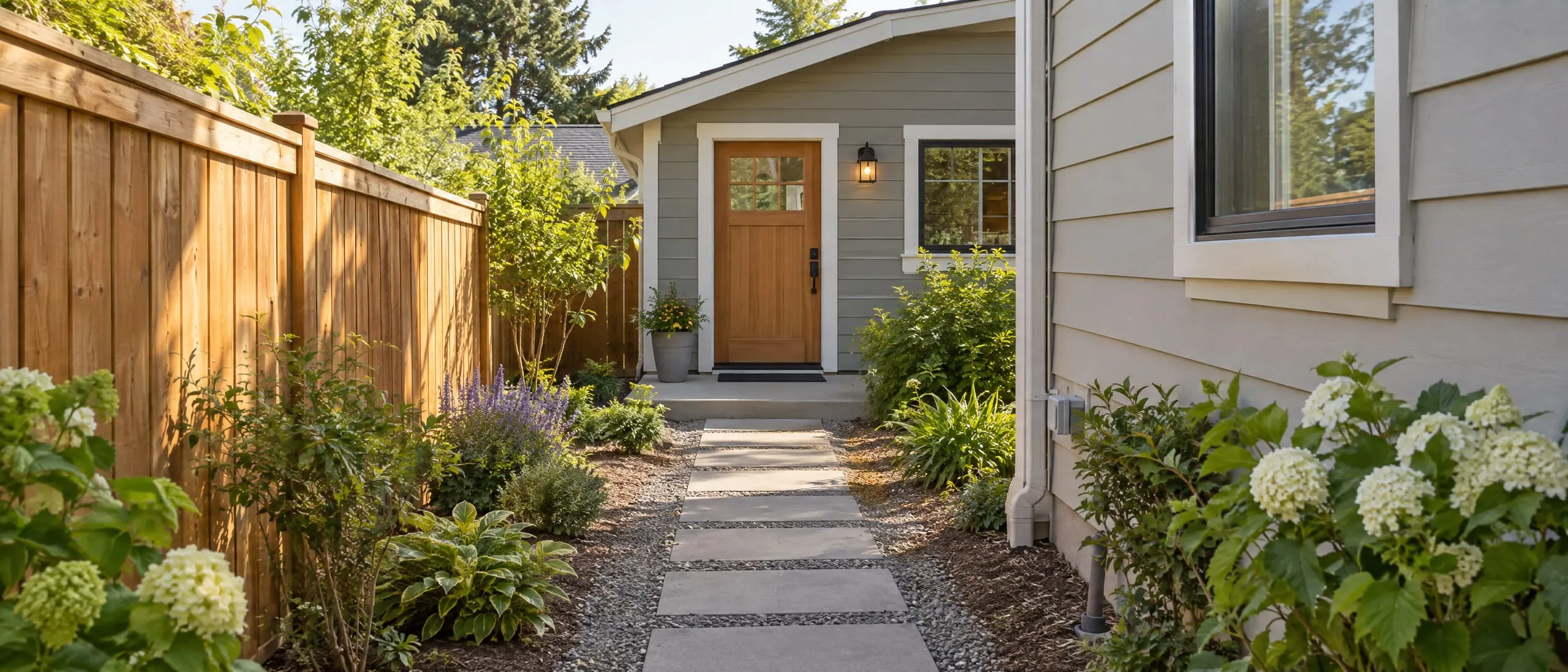
Lending on an existing ADU is opening up; paying to build one is still the hard part
Two transactions need to be kept apart: buying or refinancing a property that already has an ADU, and paying to create one. A completed unit can be inspected and compared with existing properties. A proposed unit adds construction, completion and future-income risk.
Research by the Terner Center and the USC Lusk Center, published in 2022 and based on more than 30 expert interviews and a literature review, found that owners commonly combined cash with mortgage financing. Home equity loans and cash-out refinances were the most common mortgage routes it identified. This is historical evidence about financing barriers and does not estimate 2026 market shares.19
01HELOC or home equity loanUses equity and keeps the existing first mortgage.
What the lender needs to resolveAvailable equity, combined debt, repayment terms and rate exposure.
02Cash-out refinanceRaises project cash through a new first mortgage.
What the lender needs to resolvePricing on the whole loan, qualification, equity and program restrictions.
03HomeStyle RenovationFinances eligible work against an as-completed appraisal.
What the lender needs to resolveEligible ADU scope, plans, contractor, draws, completion and value.
04CHOICERenovationAdds or renovates an eligible ADU with Freddie Mac financing.
What the lender needs to resolveFreddie Mac’s property, construction and income requirements.
05FHA Standard 203(k)Finances eligible rehabilitation and certain ADU work.
What the lender needs to resolveAttached new unit or existing unit scope, and separate income rules.
06Portfolio construction loanA bank’s customized construction path.
What the lender needs to resolveThe institution’s underwriting, liquidity, exit and completion risk.
07Public assistanceReduces selected development costs.
What the lender needs to resolveProgram availability, income limits, covenants and fit with the loan.
The risk descriptions are editorial analysis. Program availability comes from the sources below, and a listed route does not promise borrower approval.
HomeStyle Renovation
The FAQs permit a detached accessory unit and eligible manufactured ADUs, subject to applicable requirements. The renovation cost limit is separate from the loan-to-value limit, and applicable municipal completion inspections are required before the renovation phase closes out.20
CHOICERenovation
Freddie Mac offers CHOICERenovation to build or renovate ADUs. When ADU rent qualifies a borrower on a one-unit primary residence, the February 2026 fact sheet limits the transaction to a purchase or no-cash-out refinance, counts 75% of lease income and caps it at 30% of total income. It requires an appraisal, an ADU sale comparable and three rent comparables including a rented ADU, and ACE is unavailable for this use. Rent from an illegal ADU cannot qualify, and landlord education requirements apply.6
2023 changes and the August 2026 handbook
FHA’s 2023 changes set a 75% calculation for qualifying rent in specified existing-ADU cases, and a 50% calculation under Standard 203(k) when the borrower has no rental history on the subject property, both using the lesser of market rent and lease rent where applicable.21 The August 2026 Handbook 4000.1 keeps the 30% effective income cap, excludes ADU rent from cash-out qualification, and allows Standard 203(k) to add an ADU attached to an existing structure or to renovate an existing attached or detached ADU. A new detached backyard unit needs a separately eligible financing route. FHA also requires separate ADU area reporting and a supportable legal rentability determination for its optional market rent analysis.22
MassHousing ADU loan
MassHousing announced a construction-to-permanent second mortgage supporting up to $250,000 for detached ADUs and $150,000 for attached ADUs, with an amortizing component and a matching zero-interest deferred component. Its program matrix describes keeping the existing first mortgage in place. These are combined program amounts with underwriting and income conditions, and they are not grants.2324
Plus One ADU
New York’s program works through local governments and nonprofits to support creating and legalizing ADUs. Its May 2026 manual includes a ten-year regulatory period and restrictions that need careful review. Public assistance can make a project feasible while changing the rights and obligations attached to the property.2526
Guaranteed single-family program
USDA proposed allowing income-producing ADUs in its guaranteed single-family program on March 31, 2026, with comments due June 1. The research did not find a final, effective rule, so treat this as a proposal.27
Appraisal material
VA’s published appraisal material recognizes ADUs and distinguishes single-family-with-ADU from two-family classification. The current handbook page redirected to a system that could not be read during research, so this article assigns VA no ADU rent percentage and no construction route.28
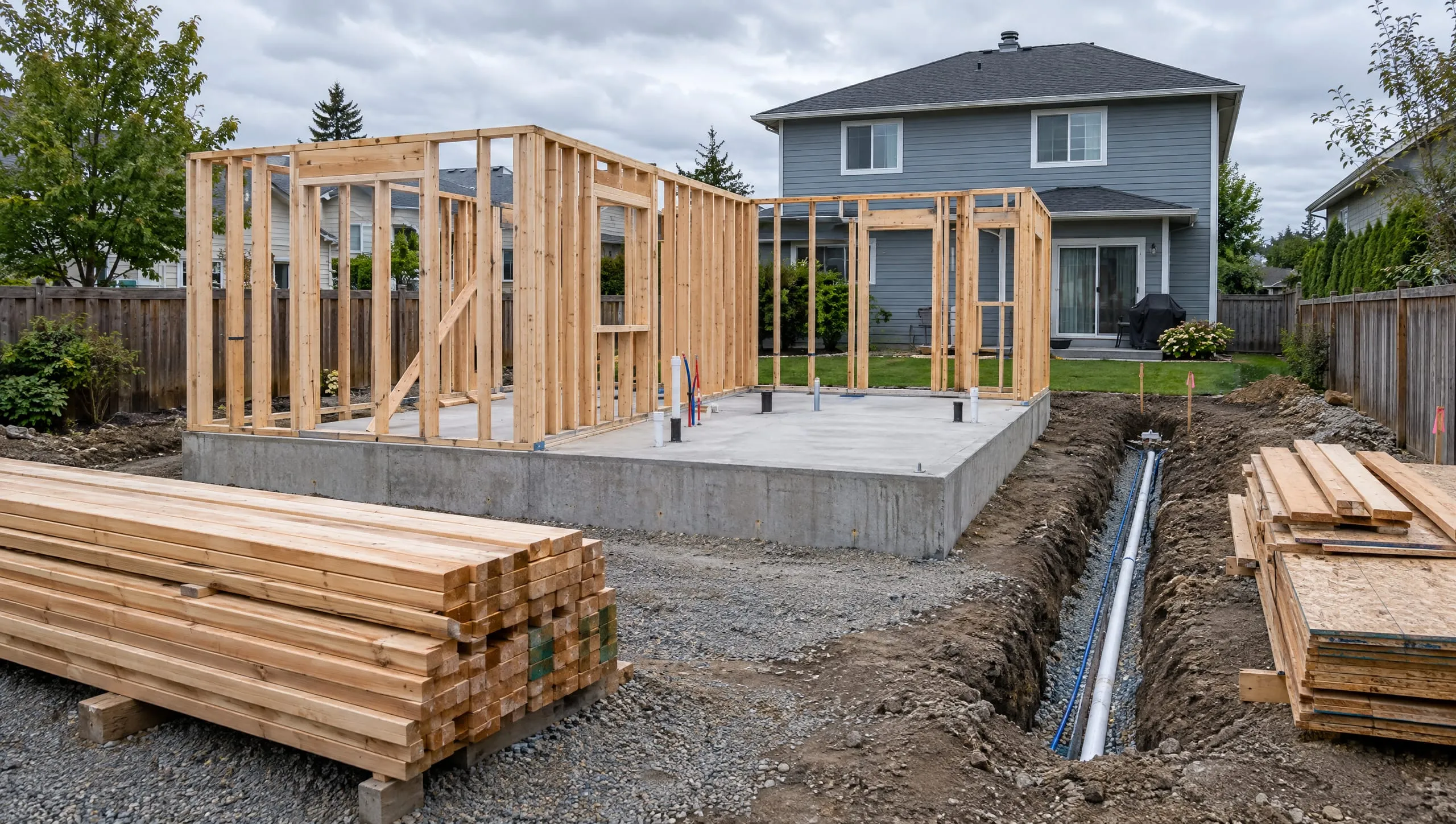
| Program | When ADU rent can qualify | How much counts |
|---|---|---|
| Fannie Mae | One existing ADU on a one-unit principal residence, purchase or limited cash-out refinance | ADU rent capped at 30% of total qualifying income16 |
| Freddie Mac | One-unit primary residence, purchase or no-cash-out refinance; an ADU sale comp and three rent comps including a rented ADU | 75% of lease income, capped at 30% of total qualifying income6 |
| FHA, existing ADU | Specified existing-ADU circumstances; lesser of market rent and lease rent | 75% calculation; 30% effective income cap; no ADU rent for cash-out qualification2122 |
| FHA, Standard 203(k) | Borrower without a rental history on the subject property | 50% calculation21 |
Property eligibility and qualifying income are separate rules. A property can fit a program’s configuration limit while only part of one unit’s rent counts.
How an ADU is valued, and why a median gap is not an adjustment
An ADU’s contributory value is the amount it adds to the value of the whole property. Construction cost, qualifying rental income and contributory value are three separate quantities.
- Construction costWhat it takes to build
- Qualifying rental incomeWhat a program lets count
- Contributory valueWhat the market adds
An appraiser begins with the property as a whole, identifies the ADU’s legal and physical characteristics, and studies how buyers respond to comparable properties. Evidence can include sales with similar ADUs, properly analyzed sales with different features, rent evidence, and cost information used as support. Comparable selection should account for location, layout, privacy, access, condition and the buyer pool.
Freddie Mac’s September 2026 appraisal guidance emphasizes determining the ADU’s effect on market value and marketability, with support even when the conclusion is no adjustment. It also highlights quality monitoring concerns and expects UAD 3.6 to improve transparency.29
A higher median value, and what it cannot show
With an ADU Without an ADU
Source: FHFA, Jan. 2, 2025.30 Not repeat sales of the same homes.
Data table
| Year | With an ADU | Without an ADU |
|---|---|---|
| 2013 | $550,000 | $405,000 |
| 2023 | $1,064,000 | $715,000 |
Source: FHFA, Jan. 2, 2025.30 The 2023 drop came during a wider fall in mortgage activity. Not a construction lending or loan performance series.
Data table
| Year | Appraisals |
|---|---|
| 2013 | 3,463 |
| 2021 | 9,246 |
| 2023 | 4,910 |
FHFA’s January 2025 study found that among California Enterprise-backed single-family purchase appraisals, 2023 median values were $1,064,000 with an ADU and $715,000 without one. The difference is $349,000, about 48.8% of the no-ADU median. The two groups differ in location, lot, home characteristics and selection into the lending sample, so the comparison cannot isolate the value an ADU adds.30
The same study reported 3,463 purchase appraisals with ADUs in 2013, 9,246 in 2021 and 4,910 in 2023. The 2023 decline from the peak came during a wider mortgage market decline. FHFA also warns of possible ADU reporting errors, and the sample excludes construction appraisals and several other property types.30
For an individual assignment, a national median cannot replace local market evidence. A costly unit may add less than its cost, and a modest conversion may be very useful to buyers.
Separate area reporting
UAD 3.6 lets the reviewer distinguish the main dwelling, the ADU and other finished areas. Fannie Mae’s measurement guidance explains that the area categories support a transparent description while adjustments still reflect market reaction, and that areas outside the usual finished-area category can contribute value.31
For example, treat a 2,000 sq ft house and a 600 sq ft ADU as identifiable components, and review the area breakdown and the adjustment treatment. Blending them into one unexplained 2,600 sq ft figure hides the property’s different uses and makes comparisons less informative.
Where each adjustment goes
The GSE FAQs describe using a total-unit row for differing unit counts and feature rows for appropriate differences in unit characteristics. They caution against adjusting twice after a unit-based adjustment already captures the difference.2
One adjustment, $90,000, captures the full unit.
Suppose an appraiser supports a $90,000 adjustment for a comparable that lacks the subject’s ADU. If that adjustment already accounts for the full unit, adding another for the same ADU’s area and rooms repeats the contribution. If the comparable instead has an ADU with materially different features, those differences may warrant separate, market-supported treatment. A reviewer should be able to follow exactly what each adjustment captures.
ADU laws are spreading, and coverage stops at population lines, growth boundaries and city limits
Mercatus Center’s August 2025 taxonomy, using its own classification, identified 18 states with laws broadly legalizing ADUs and examined 18 policy variables, including parking, owner occupancy and discretionary review. It is a historical classification that helps explain variation. It does not give a current 2026 state count or show permission on every parcel.32
- Selected policy example
- Selected funding example
- Local example
- Not assessed in this article
Tile map of this article’s coverage. Colors are not a legal permissiveness score, and gray states were not assessed and are not shown as prohibiting ADUs. Tiles are arranged by approximate position, not area.
California
Broad framework with parcel and local conditions
Broad statutory framework. The March 2026 HCD handbook incorporates the 2026 changes. Local agencies can adopt a separate-conveyance ordinance subject to statutory conditions.7
For the collateral reviewerVerify local implementation, title structure and consent requirements before treating an ADU as independently saleable.
Research checked Oct. 11, 2026. Verify the local rules for any parcel.
Washington
Covered urban growth areas
Within covered urban growth areas, cities and counties must generally allow at least two ADUs per lot, and owner-occupancy requirements are limited. Environmental, sewer and other exceptions remain.3334
For the collateral reviewerMap the parcel to the applicable area and verify physical constraints.
Research checked Oct. 11, 2026. Verify the local rules for any parcel.
Oregon
Population thresholds and urban growth boundaries
ORS 197A.425 requires at least one ADU in specified urban growth boundary areas for cities over 2,500 people and counties over 15,000. It limits owner-occupancy and extra parking requirements.35
For the collateral reviewerState coverage has population and geographic boundaries.
Research checked Oct. 11, 2026. Verify the local rules for any parcel.
Colorado
Defined metropolitan subject jurisdictions
HB24-1152 requires administrative approval of one ADU in covered jurisdictions from June 30, 2025. Coverage is tied to population and metropolitan planning boundaries.36
For the collateral reviewerA Colorado address alone does not establish coverage.
Research checked Oct. 11, 2026. Verify the local rules for any parcel.
Arizona
Municipalities over 75,000, with exceptions
A.R.S. 9-461.18 applies to municipalities above 75,000 people and requires attached and detached ADU allowances, with stated exceptions. Private covenants remain relevant.37
For the collateral reviewerThe statute’s ADU definition may include a unit without its own kitchen, which differs from mortgage guidance.
Research checked Oct. 11, 2026. Verify the local rules for any parcel.
Massachusetts
Protected-unit standards; Boston exception
Protected ADUs are capped at the smaller of 900 square feet or half the principal home’s gross floor area. State FAQs identify Boston as outside the Chapter 40A law’s coverage.3839
For the collateral reviewerSeparate the protected size standard and jurisdictional coverage from broader local options.
Research checked Oct. 11, 2026. Verify the local rules for any parcel.
Maryland
Local-law requirement with an implementation deadline
Land Use § 4-504 required local laws by Oct. 1, 2026. Public facility requirements remain, and parking may be regulated with a study and waiver process.40
For the collateral reviewerCheck the adopted local ordinance now that the deadline has passed.
Research checked Oct. 11, 2026. Verify the local rules for any parcel.
New York
Participating assistance programs; zoning not assessed statewide
The Plus One ADU program funds ADU creation and legalization through participating local governments and nonprofits.2526
For the collateral reviewerFunding participation does not establish statewide by-right zoning.
Research checked Oct. 11, 2026. Verify the local rules for any parcel.
Austin, Texas
Austin example only; no statewide classification assigned
Austin’s HOME Phase 1 allows up to three units on covered SF-1, SF-2 and SF-3 properties under its specified review categories.41
For the collateral reviewerAustin’s infill rules do not carry over to other Texas cities and do not determine GSE classification.
Research checked Oct. 11, 2026. Verify the local rules for any parcel.
All nine examples as a table
| Jurisdiction | Verified policy direction | Why the collateral reviewer should care |
|---|---|---|
| California | Broad statutory framework. The March 2026 HCD handbook incorporates the 2026 changes. Local agencies can adopt a separate-conveyance ordinance subject to statutory conditions.7 | Verify local implementation, title structure and consent requirements before treating an ADU as independently saleable. |
| Washington | Within covered urban growth areas, cities and counties must generally allow at least two ADUs per lot, and owner-occupancy requirements are limited. Environmental, sewer and other exceptions remain.3334 | Map the parcel to the applicable area and verify physical constraints. |
| Oregon | ORS 197A.425 requires at least one ADU in specified urban growth boundary areas for cities over 2,500 people and counties over 15,000. It limits owner-occupancy and extra parking requirements.35 | State coverage has population and geographic boundaries. |
| Colorado | HB24-1152 requires administrative approval of one ADU in covered jurisdictions from June 30, 2025. Coverage is tied to population and metropolitan planning boundaries.36 | A Colorado address alone does not establish coverage. |
| Arizona | A.R.S. 9-461.18 applies to municipalities above 75,000 people and requires attached and detached ADU allowances, with stated exceptions. Private covenants remain relevant.37 | The statute’s ADU definition may include a unit without its own kitchen, which differs from mortgage guidance. |
| Massachusetts | Protected ADUs are capped at the smaller of 900 square feet or half the principal home’s gross floor area. State FAQs identify Boston as outside the Chapter 40A law’s coverage.3839 | Separate the protected size standard and jurisdictional coverage from broader local options. |
| Maryland | Land Use § 4-504 required local laws by Oct. 1, 2026. Public facility requirements remain, and parking may be regulated with a study and waiver process.40 | Check the adopted local ordinance now that the deadline has passed. |
| New York | The Plus One ADU program funds ADU creation and legalization through participating local governments and nonprofits.2526 | Funding participation does not establish statewide by-right zoning. |
| Austin, Texas | Austin’s HOME Phase 1 allows up to three units on covered SF-1, SF-2 and SF-3 properties under its specified review categories.41 | Austin’s infill rules do not carry over to other Texas cities and do not determine GSE classification. |
For a lending file, legality has several layers. A legal nonconforming use needs its own treatment, including any rebuilding rights, and unpermitted construction and prohibited zoning use need separate investigation.
- 01Allowed use under zoning
- 02Construction approval and permits
- 03Occupancy authorization, where required
- 04Rental permission, including short-term rules
- 05Private restrictions and covenants
- 06Rights the mortgage actually encumbers
An ADU may be allowed for residential occupancy while short-term rental use is restricted, and a unit permitted for family use may raise different rental questions. A state reform can remove a zoning barrier while sewer capacity, flood exposure, wildfire requirements, easements or private restrictions still affect feasibility. Review the parcel’s actual documents.
Cost, cash flow and collateral contribution on the same screen
For a proposed ADU, put cost, cash flow and collateral contribution next to each other. The scenario below uses invented inputs, for explanation only.
All outputs are illustrative cash flow before income taxes, including the selected reserve assumption. They do not calculate agency qualifying income or investment suitability.
On the default inputs, debt principal and interest come to about $1,673 a month. After the $100 vacancy allowance and the $600 operating and reserve allowance, the unit produces $1,300 a month before debt service, so cash flow is about negative $373 a month. Gross annual rent divided by project cost is 9.6%, a figure that leaves out expenses and financing.
At $2,500 monthly rent, with the same vacancy and expense assumptions, cash flow is about positive $102 a month. With a 10% cost overrun funded by a proportional loan increase to $220,000, debt service rises to about $1,840 a month, and the $2,000 rent case falls to about negative $540 a month.
These are sensitivity calculations. Actual taxes, insurance, utilities, management, maintenance, reserves and loan terms need to be researched for the property. The operating and reserve allowance is a teaching input and not a benchmark. Cash flow here is before income taxes and is not a lender’s qualifying income calculation.
The dashed segment is project cost outside the hypothetical contribution estimate. Do not add this example to a home price to infer a whole-property value.
Now suppose local sales evidence supports only $150,000 of incremental collateral contribution. Spending $250,000 would leave $100,000 of project cost outside that contribution estimate. That hypothetical outcome can matter greatly to construction lending and refinance expectations, even if the household values the ADU for family use.
Historical costs provide context only. A California owner survey published in 2021 reported a $150,000 median construction cost and $2,000 median rent. Those figures should not be used as 2026 construction bids or nationwide rent assumptions.42
Seven steps for an ADU file, from intake through delivery
Treat the ADU as an identifiable part of the property from intake through delivery.
- 1Identify the structures and units
Reconcile the application, public records, listing, photos and appraisal.
- 2Establish legal use and rental rights
Record the ordinance or responsible authority, permits, occupancy documents where applicable, and private restrictions.
- 3Select the actual program and format
Determine the investor, occupancy, construction type, transaction purpose and UAD version before promising a financing path.
- 4Review the value explanation
Trace area, condition, comparable selection and adjustment support. Check for omitted components and double counting.
- 5Review rent separately
Confirm which unit the rent belongs to and whether the selected program permits that income.
- 6For construction, test completion and exit
Review utilities, site work, contingency, draws, liens and the as-completed valuation.
- 7Keep records that help the next file
Consistent ADU identification makes the next assignment easier to compare and the portfolio easier to understand.
These steps are an editorial workflow and do not replace the investor’s full requirements.
Dates and open questions
UAD 3.6 mandate for appraisals delivered to Fannie Mae and Freddie Mac.18
Reduced functionality begins for UAD 2.6 reports submitted under the exception.18
Last day for UAD 2.6 submissions under the exception.18
A final USDA rule on income-producing ADUs. The proposal’s comment period closed June 1, 2026.27
Maryland local ordinances adopted under Land Use § 4-504 after the Oct. 1, 2026 deadline.40
VA’s current ADU underwriting detail. The handbook page could not be read during research.28
We found no national series on ADU loan originations or loan performance. Policy items marked with a date or as open should be rechecked against the current Fannie Mae, Freddie Mac, HUD and state documents before relying on them.

The lending result on any one parcel depends on whether local law permits the unit, whether the economics work, whether market evidence supports the value, and whether the report describes the property accurately.
Research checked Oct. 11, 2026; the underlying data years differ and are stated with each figure. Dimensions, values, rents, the walkthrough parcel and the cash-flow scenario are illustrative and labeled. The state map shows this article’s coverage, not legal permissiveness, and is not a 50-state survey. Images and the hero motion clip were generated with Higgsfield as architectural illustrations and do not show real properties, people or legal configurations. No interviews were conducted for this article. General information, not legal, lending or investment advice.
Sources
42 documents, accessed Oct. 11, 2026
- Fannie Mae, Selling Guide Supplement: UAD 3.6 Policy, SB2-3-04September 2026
- Fannie Mae and Freddie Mac, UAD and Forms Redesign FAQs, FAQs 29 and 30Current PDF
- Fannie Mae, Appraiser Update: ADU policy changesMarch 2026
- Fannie Mae Selling Guide B2-3-04, Special Property Eligibility ConsiderationsOct. 8, 2025
- California HCD, ADUs and JADUs (housing element building blocks)Current page
- Freddie Mac, Accessory Dwelling Unit fact sheetFebruary 2026
- California HCD, Accessory Dwelling Unit HandbookMarch 2026
- Fannie Mae and Freddie Mac, Appendix F-1 URAR Reference Guide, version 1.4March 2026
- Freddie Mac, Identifying ADUs from Real Estate Listing Descriptions Using Text MiningJuly 16, 2020
- Freddie Mac, ADUs Can Increase Housing Stock, But Most Are UnfamiliarJan. 24, 2023
- California Department of Finance, E-1 population and housing estimates press release2026
- Massachusetts, More Than 2,000 ADUs Approved Under Governor Healey’s Housing BillAug. 12, 2026
- Fannie Mae Selling Guide B4-1.3-05, Improvements Section of the Appraisal ReportJune 4, 2025
- Fannie Mae and Freddie Mac, UAD 3.6 Inspection and Reporting TipsCurrent PDF
- Fannie Mae and Freddie Mac, Mapping Legacy Forms to the Redesigned URAR: property typeCurrent PDF
- Fannie Mae Selling Guide B3-3.8-02, Rental Income from the Subject PropertySept. 2, 2026
- Fannie Mae, Appraiser Update: highest and best useSeptember 2026
- Fannie Mae, Lender Letter LL-2026-08, temporary policy exception for lenders unable to meet the UAD 3.6 mandateSept. 30, 2026
- UC Berkeley Terner Center and USC Lusk Center, ADU Construction FinancingJuly 6, 2022
- Fannie Mae, HomeStyle Renovation FAQsDec. 10, 2025
- HUD, Mortgagee Letter 2023-17, ADU policy changesOct. 16, 2023
- HUD, Single Family Housing Policy Handbook 4000.1, Update 18Aug. 12, 2026
- MassHousing, ADU construction loan program announcementJan. 14, 2026
- MassHousing, ADU Loan Program matrixJan. 12, 2026
- New York Homes and Community Renewal, Plus One ADU programCurrent page
- New York HCR, Plus One ADU Program policy manualMay 2026
- USDA Rural Development, proposed rule on income-producing ADUs in the guaranteed loan programApril 1, 2026
- VA, Lender Handbook (VA Pamphlet 26-7), ADU appraisal materialIndexed PDF
- Freddie Mac, A Practical Guide to Appraising Accessory Dwelling UnitsSept. 9, 2026
- FHFA, Trends in Median Appraised Value for Properties With ADUs in CaliforniaJan. 2, 2025
- Fannie Mae, Standardizing Property Measuring GuidelinesSept. 4, 2025
- Mercatus Center, A Taxonomy of State Accessory Dwelling Unit Laws, 2025August 2025
- Washington Legislature, RCW 36.70A.681, accessory dwelling unitsCurrent code
- Washington Legislature, RCW 36.70A.680, coverage and exceptionsCurrent code
- Oregon Legislature, ORS 197A.425Current chapter
- Colorado General Assembly, HB24-1152, accessory dwelling unitsEnacted May 13, 2024
- Arizona Legislature, A.R.S. 9-461.18Current code
- Massachusetts, ADU law: Acts of 2024, Chapter 150, sections 7 and 8Current page
- Massachusetts, Accessory Dwelling Unit FAQsSept. 17, 2026
- Maryland General Assembly, Land Use § 4-504Current statute
- City of Austin Development Services, HOME amendmentsData updated Oct. 6, 2026
- Terner Center and Center for Community Innovation, first statewide ADU owner surveyApril 22, 2021
The Signal / Monthly briefing
Follow valuation policy, collateral risk and property technology, with sources.
One sourced briefing in the first week of each month.
Unsubscribe in one click. We don't sell your email or share it with sponsors. Privacy Policy