The Signal / State boards / October 4, 2026
Kentucky House Bill 355
One year, then it closes.
A newly formed group of Kentucky appraisers helped write a bill, saw it pass 133 to 0, and watched lawmakers override the governor's veto. Most lawsuits and board complaints against Kentucky appraisers now have to come within a year of the report. The same law lifted the cap on their license fees.
A young association took a bill from first draft to the statute books in a single session.
The Kentucky Association of Appraisers (KAA) is young. It was founded within the last two years, and its early posts counted members in the dozens. The association describes itself as a place for Kentucky appraisers to network and learn. In 2026 it also helped write House Bill 355, a broad rewrite of Kentucky's appraisal law. KAA ↗
KAA president Bryan S. Reynolds says the association spent about five months working with Rep. Shawn McPherson, legislative counsel and bill drafters. He calls the result "one of the most significant pieces of appraisal-related legislation ever enacted in the Commonwealth." Reynolds in Working RE, May 13 ↗
- Founding presidentBryan Reynolds
- Vice presidentJarrett Hardesty
- TreasurerDoug Watson
- SecretaryChris Stewart, MAI
The session
133 to 0. Then a veto.
HB 355 cleared both chambers without a single no vote. The governor vetoed it anyway, and four days later the General Assembly overrode him. Legislative record ↗
- Dec 2025
Drafted and prefiled
KAA works with Rep. Shawn McPherson, legislative counsel and bill drafters. Reynolds says the drafting took about five months.
- Jan 13
Introduced in the House
Primary sponsor Rep. Shawn McPherson, with Reps. G. Brown Jr. and M. Pollock.
- Feb 18
Out of committee
House Banking & Insurance reports it favorably with a committee substitute. Reynolds testified before this committee.
- Mar 31
To the governor
The House concurs in the Senate changes and the bill goes to Gov. Andy Beshear.
- Apr 10
Vetoed
On the last day available to him, the governor vetoes the bill in its entirety.
- Apr 14
Override
Both chambers override. HB 355 becomes Acts Chapter 172.
- Jul 15
In force
The Real Estate Appraisers Board becomes the Real Property Appraisers Board.
The core protection
The clock starts when you send the report.
Before HB 355, someone could file a board complaint up to five years after an appraisal report was sent, or two years after the end of a court case in which the appraiser testified about the assignment, whichever came later. Under Kentucky's general rules, a lawsuit's clock could start when the client discovered the alleged problem, not when the report was delivered. The governor's veto message describes that rule. Veto message ↗
Now a lawsuit for damages against a licensed or certified appraiser, or an appraisal management company, must be filed within one year after "the appraisal report has been completed and transmitted to the client." The law covers contract claims, tort claims and claims on any other basis, and it applies "notwithstanding any statutory provision to the contrary." Act, Section 2 ↗
Bar lengths are drawn to scale against a five-year axis. The open-ended bar represents a discovery-based start.
The fine print
Some complaints can still come later.
The new one-year window for board complaints replaces the old five-year rule, but it does not cover every kind of misconduct. Under the amended KRS 324A.052, complaints based on these grounds in KRS 324A.050(1) are not subject to the one-year limit: Act, Sections 9 and 18 ↗
- (c)
A felony or misdemeanor conviction, handled under KRS Chapter 335B
- (d)
An act involving dishonesty, fraud or misrepresentation
- (g)
Other conduct showing bad faith, untrustworthiness, impropriety, fraud or dishonesty
- (k)
Discipline in another state on grounds that would also justify discipline in Kentucky
The one-year limit protects appraisers against claims of honest error, such as negligence, a USPAP lapse or a weak adjustment. It does not cover dishonesty. Fraud lawsuits keep a five-year window.
Peer review, defined
Reviewed by someone who has done your work.
HB 355 sets minimum qualifications for anyone the board uses to investigate a complaint or review an appraisal. An appraiser can challenge an investigation or review done by someone who doesn't meet them. In June the board adopted a procedure for those challenges: they must be in writing and filed within 30 days of the board's disciplinary letter. Act, Section 3 ↗ June 26 minutes ↗
A new board
Seven seats, up from five.
The Real Estate Appraisers Board is now the Real Property Appraisers Board, an independent agency attached to the Department of Professional Licensing. No more than four members may come from the same political party. Any new executive director must be a certified appraiser with at least ten years of experience in Kentucky. The governor has until July 2027 to fill the two new seats. Board site ↗
- Certified general appraiser
- Certified general appraiser
- Certified residential appraiser
- Certified residential appraiser
- Public member
- Lending industry
- Lending industry
The governor's case
"Injured parties would have to file lawsuits even if they had not yet discovered wrongful conduct."
Gov. Andy Beshear's veto message made two arguments. First, the bill would limit people's access to the courts by starting the clock when a report is delivered rather than when harm is discovered. Second, the new complaint deadline could put Kentucky at odds with federal standards. Those standards, he wrote, require the board to look into the merits of a complaint before dismissing it on timing alone, and failing to meet them risks a "potential loss of federal funds." Veto message ↗
The House overrode 79 to 15 and the Senate 30 to 6 on April 14. That is short of the earlier unanimous votes but well above the simple majority Kentucky requires to override.
The federal question is still open. At a June 11 special meeting, the appraisal board's minutes record a discussion of "HB 355 being in conflict with federal USPAP regulations," and the board voted to find a legislative sponsor to amend the USPAP language in the law. June 11 minutes ↗
The trade-off
An independent board sets its own fees.
The old statute capped most license fees. The annual certificate or license fee for appraisers in federally related transactions could not exceed $200. HB 355 removed those dollar caps. Fees now must be set by regulation, at no more than what the board needs to run and enforce the chapter. The Appraisal Institute says the cap was removed late in the process, after stakeholders had already backed the bill. Act, Section 10 ↗ Appraisal Institute ↗
The new board also has to fund itself. At a May meeting, staff told the board it held about $2 million but had no spending authority above $65,000. The board's June votes approved a budget, three staff positions, $30,000 for outside litigation counsel and a temporary employee for the HB 355 transition. June 26 minutes ↗
The Appraisal Institute warned that "licensing fees of this magnitude could create an unnecessary barrier" and said it would submit comments. Its concern is for small firms, rural appraisers and people entering the profession. The fees take effect through administrative regulation, which has a public comment period. Kentucky appraisers who want to weigh in should watch for it.
Beyond liability
Four other changes.
Evaluations are allowed
Licensed and certified appraisers may provide evaluations under the federal interagency guidelines. They must not state their credential, and the first page must read: "This evaluation is not subject to compliance with the Uniform Standards of Professional Appraisal Practice."
Two-year renewals
Licenses renew every two years instead of every year, with 28 hours of continuing education per cycle. The 7-hour National USPAP Update must be completed in the first six months. The board voted to start the biennial cycle on July 1, 2027. Minutes ↗
Real property
"Real estate appraisal" becomes "real property appraisal" throughout the chapter. The act also adds definitions for evaluations and for real property-related financial transactions.
Prosecutors on call
The board can refer violations to the Attorney General, Commonwealth's attorneys and county attorneys, who must assist when asked. Fines remain capped at $2,000 per violation and $5,000 in total. KRS 324A ↗
Field guide
When does your clock start?
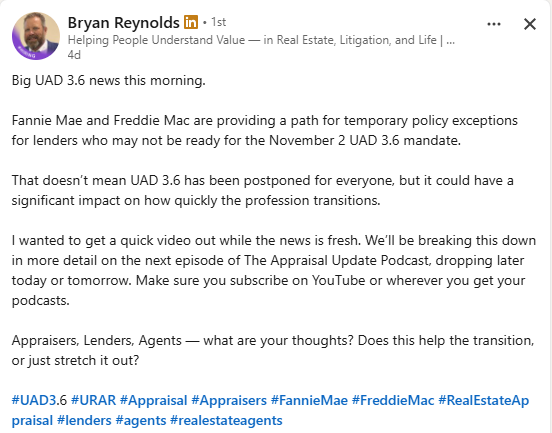
"Even if your state appears to provide a five-year statute of limitations, the critical question is from when does that period begin to run."
- 01
Find your civil limitations period.
Check whether it runs from the report date, from delivery or from discovery. A discovery rule can leave you exposed for decades.
- 02
Find your board's complaint window.
Many states set it in board regulations rather than in statute. Note which kinds of misconduct are exempt from it.
- 03
Ask who investigates you.
Kentucky now requires investigators with at least the same credential and experience with the same property type. Find out what your state requires.
- 04
Read the whole bill.
Kentucky's included a fee change that critics say was added late. Find the fee provisions before you endorse a bill.
Kentucky's appraisers organized fast, wrote a specific bill and kept enough support to override a veto. In one session, they moved the start of their liability clock from discovery to delivery of the report. Appraisers in other states can find out where their own clock starts.
Sources checked October 4, 2026, against the enrolled act (Acts Chapter 172), the governor's veto message, the House and Senate vote history and the appraisal board's May–June 2026 minutes. This article summarizes the law and is not legal advice. Appraisers facing a claim should talk to counsel about how the new limits apply to reports sent before July 15, 2026.
The Signal / Monthly briefing
State boards move fast. So do we.
One sourced briefing in the first week of each month.
Unsubscribe in one click. We don't sell your email or share it with sponsors. Privacy Policy