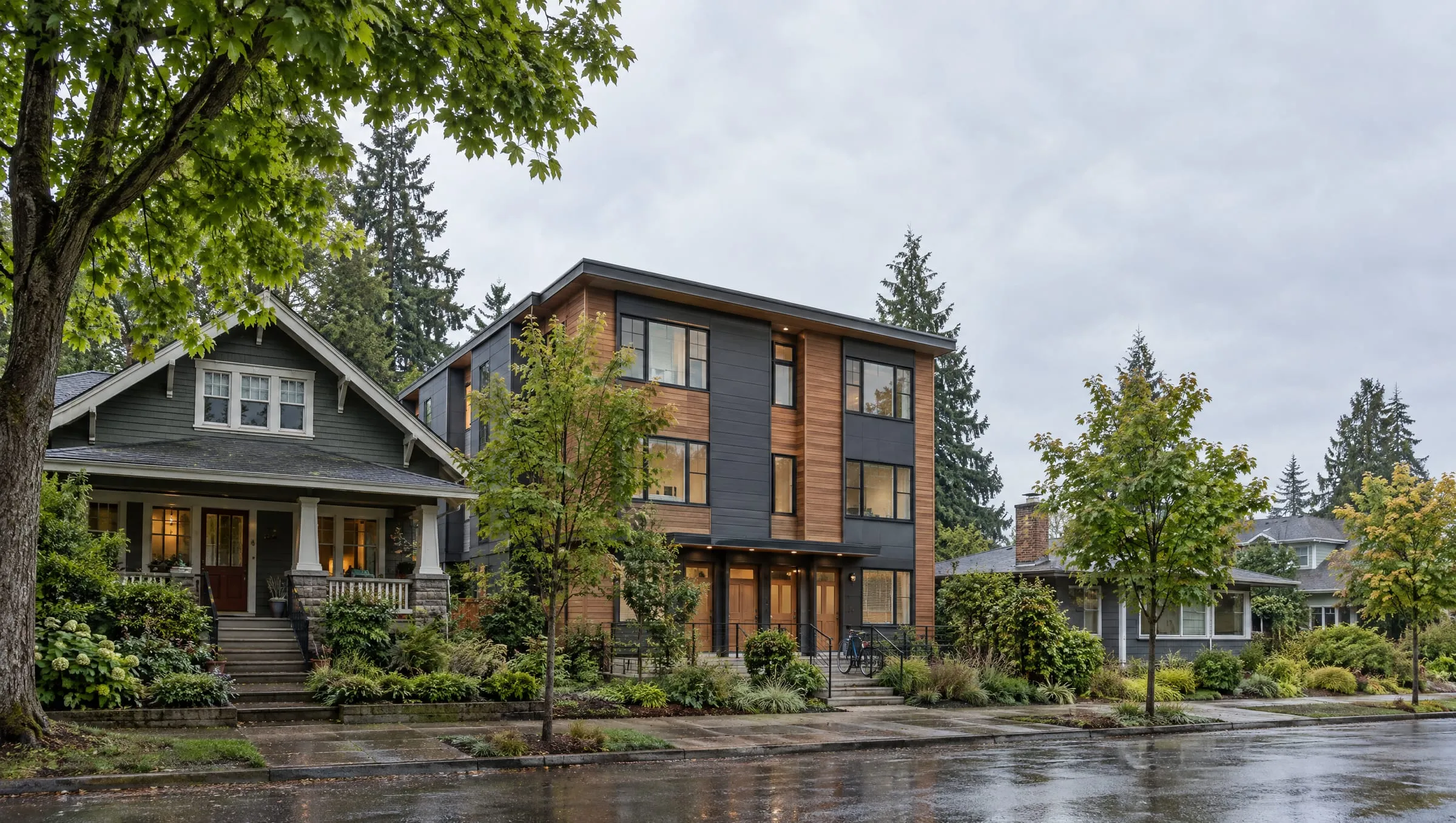
The Signal / Washington land use / October 10, 2026
HB 1110 and the laws that followed
Washington upzoning, HB 1110 to today The lot, the law and the comps
Washington’s 2023 middle housing law requires 77 cities to allow 2 to 6 units on nearly every residential lot, and a companion law allows two ADUs per lot in every urban growth area. The rules took effect county by county from mid-2025, and laws passed in 2024, 2025 and 2026 changed parking, transit station areas, lot splits, rents and condo warranties.
Under state law
- Cities subject to HB 1110
- 77
- Units per lot, cities of 75,000+
- 4
- Within 1/4 mile of major transit
- 6
- ADUs per lot in urban growth areas
- 2
Middle housing
A minimum number of homes on every residential lot, on a date set by each county’s plan update
HB 1110 (Chapter 332, Laws of 2023, codified mainly at RCW 36.70A.635) took effect July 23, 2023. RCW 36.70A.635 ↗ It sets a minimum number of units per lot on all lots zoned predominantly residential in cities that fully plan under the Growth Management Act. Each city must comply six months after its next periodic comprehensive plan update, so the date the rules apply varies by county. Final Bill Report ↗
Affordable units must carry a recorded covenant for at least 50 years and match the market units in size and bedroom count. Cities with an existing affordable housing incentive program may substitute their own terms. A major transit stop covers high-capacity transit, commuter rail, rail or fixed guideway, and bus rapid transit stops.
Rules cities must follow
- Duplex
- Triplex
- Fourplex
- Fiveplex
- Sixplex
- Townhouse
- Stacked flat
- Courtyard apartment
- Cottage housing
- Types
Allow at least six of the nine middle housing types. ADUs may count toward the unit count.
- Review
Design review for middle housing may only be administrative.
- Standards
No stricter than for a detached single-family house; permitting and SEPA review must be the same.
- Subdivision
Allow zero lot line short subdivisions creating as many lots as the required density. Lots under 1,000 sq ft after subdivision need not reach the per-unit density.
- Parking
None within 1/2 mile walk of a major transit stop; at most 1 space per unit on lots under 6,000 sq ft and 2 on larger lots, unless Commerce certifies a city’s empirical safety study.
- Covenants
New CC&Rs and HOA declarations created after the effective date cannot prohibit the added units. Existing covenants are not voided.
Carve-outs that reach individual parcels
- 01
Critical areas
Lots with critical areas or their buffers, lots in impaired watersheds serving a potable reservoir, and designated urban separators. After ESHB 2321, only the affected portion of a lot.
- 02
Sea-Tac
Areas within 1 mile of a commercial airport with 9 million or more annual enplanements are exempt from the parking limits.
- 03
Water and sewer
Density may be limited where water supply is inadequate; lots on septic can be held to 2 units until sewer arrives.
- 04
Alternative compliance
A city may apply the rules to at least 75% of single-family lots. The excluded 25% must include critical areas, certified extension areas and hazard areas; areas within 1/2 mile of major transit and areas once covered by racially restrictive covenants generally stay in.
If a city misses its deadline, Commerce’s model ordinance supersedes local code until the city acts. Commerce ↗
HB 1337, two ADUs per lot. HB 1337 applies in all GMA urban growth areas, not only the HB 1110 cities. Cities and counties must allow two ADUs per lot (attached, detached or one of each) on any lot that meets the minimum lot size for the principal unit, and cannot require owner occupancy. They cannot bar the separate sale of an ADU organized as a condominium solely because it was built as an ADU. Parking caps mirror HB 1110. Senate Bill Report ↗ MRSC ↗
SB 5258, unit lot subdivisions. SB 5258 amended RCW 58.17.060 to require unit lot subdivision procedures in short plat codes. The parent lot must meet zoning standards; the individual unit lots need not, and each one is a separately sellable legal lot with its own parcel number. Plats must carry notes on the unit lots’ limits and potential nonconformities. RCW 58.17.060 ↗ Commerce ULS fact sheet ↗ This is the mechanism that turns a fourplex lot into four fee-simple townhome sales.
Follow-on legislation
Ten more laws changed what can be built, financed or sold on a residential lot
The Legislature amended or extended the framework in each session since 2023. Newest first.
- 2026Ownership
HB 2304 Condo warranty expansion
Extends the insured express-warranty alternative to new or conversion condo buildings of 12 or fewer units and 4 or fewer stories, which covers stacked flats. A companion bill exempts small middle-housing plat communities (6 or fewer units, assessments of $1,000 or less a year) from most WUCIOA provisions and from reserve studies.
Effective: June 11, 2026 Source ↗
- 2026Land use
SHB 2269 Rural sewer option
Where a rural county opts to allow middle housing in a LAMIRD, a large on-site sewage system (3,500 to 100,000 gpd) can serve it. It does not mandate rural middle housing.
Effective: June 11, 2026 Source ↗
- 2025Parking
ESSB 5184 Parking Reform and Modernization Act
Cities over 30,000 and counties may require no more than 0.5 space per multifamily unit, 1 per single-family home and 2 per 1,000 sq ft commercial. None for units of 1,200 sq ft or less, affordable, senior, childcare, or changes of use.
Effective: July 27, 2025; cities of 50,000+ within 18 months, 30,000 to 50,000 within 3 years Source ↗
- 2025Land use
HB 1491 Transit-oriented development
Station areas (1/2 mile of light rail and most commuter rail, 1/4 mile of qualifying BRT) must allow an average 3.5 FAR at rail or 2.5 FAR at BRT, with no off-street parking and 50-year affordability set-asides. Adds a 20-year property tax exemption and a 50% impact fee cut for qualifying projects.
Effective: Central Puget Sound cities by Dec. 31, 2029 Source ↗
- 2025Land use
E2SHB 1096 Lot splitting
HB 1110 cities must offer an administrative lot split processed with the building permit: one new lot, both meeting minimum lot size, no repeat splits, and no cut in allowed units below the parent lot’s pre-split zoning.
Effective: Adopt by July 27, 2027, or with a 2027 periodic update Source ↗
- 2025Ownership
SB 5559 Unit lot subdivisions
Clarifies ULS definitions and vesting. Unit lot plats must notify purchasers of the lot’s legal status, including limits on future development and potential nonconformities.
Effective: Notice required by June 30, 2026 Source ↗
- 2025Ownership
HB 1403 Condo warranty
First insured express-warranty alternative for ADU condos and small condo buildings created on or after July 27, 2025.
Effective: July 27, 2025 Source ↗
- 2025Income
HB 1217 Rent stabilization
Caps yearly rent increases at 7% plus CPI or 10%, whichever is lower. New construction is exempt for 12 years; the caps sunset after 15 years.
Effective: May 7, 2025 Source ↗
- 2025Land use
SB 5558 Deadline changes
Moved periodic update deadlines to Dec. 31, 2026 for ten Central and Eastern Washington counties and their cities; the middle housing and ADU rules follow that date.
Effective: Varies Source ↗
- 2024Land use
ESHB 2321 Cleanup
Transit bonus applies to BRT stops under construction. Critical area exemption limited to the affected part of a lot. Lots created by splitting a single residential lot are exempt from the density mandate. Lots of exactly 6,000 sq ft capped at 1 space per unit.
Effective: June 6, 2024 Source ↗
Referendum status. A group called Safe Eastside filed repeal referenda against SB 5184 and HB 1491 in June 2025 and needed about 155,000 signatures by July 26, 2025. The Urbanist ↗ We found no public record of the petition result. Both laws are being implemented: Commerce publishes parking and TOD guidance, and PSRC reports 20 of 25 affected central Puget Sound cities had already cut parking minimums. PSRC ↗ Confirm status with the Secretary of State if a report relies on either law. Secretary of State ↗
Stacked parking rules. One project may face the HB 1110 cap, the SB 5184 cap, the HB 1491 station-area prohibition and a stricter local rule at once. The most permissive state limit controls.
Compliance dates
The same statute took effect in different counties up to two years apart
Commerce counts 77 cities subject to HB 1110 and publishes the list. Commerce ↗ Jurisdiction list ↗ Compliance dates follow the GMA periodic update schedule in RCW 36.70A.130. RCW 36.70A.130 ↗
- King, Pierce, Snohomish, KitsapIn effect
Seattle interim code June 30, 2025, permanent Jan. 21, 2026. Tacoma Feb. 1, 2025.
- Clark, Whatcom, Thurston, Skagit, Island and other 2025 countiesIn effect, or the model ordinance governs
- Spokane, Benton, Franklin, Yakima, Chelan, Douglas, Cowlitz, Kittitas, Skamania, Walla WallaPending (moved by SB 5558)
Watch Spokane Valley, Kennewick, Pasco, Richland and Yakima.
- Grant, Grays Harbor, Whitman and other 2027 countiesPending
Sources: Commerce Planners’ Newsletter ↗ Commerce deadline sheet ↗ Confirm a specific city on Commerce’s deadline sheet before relying on this table.
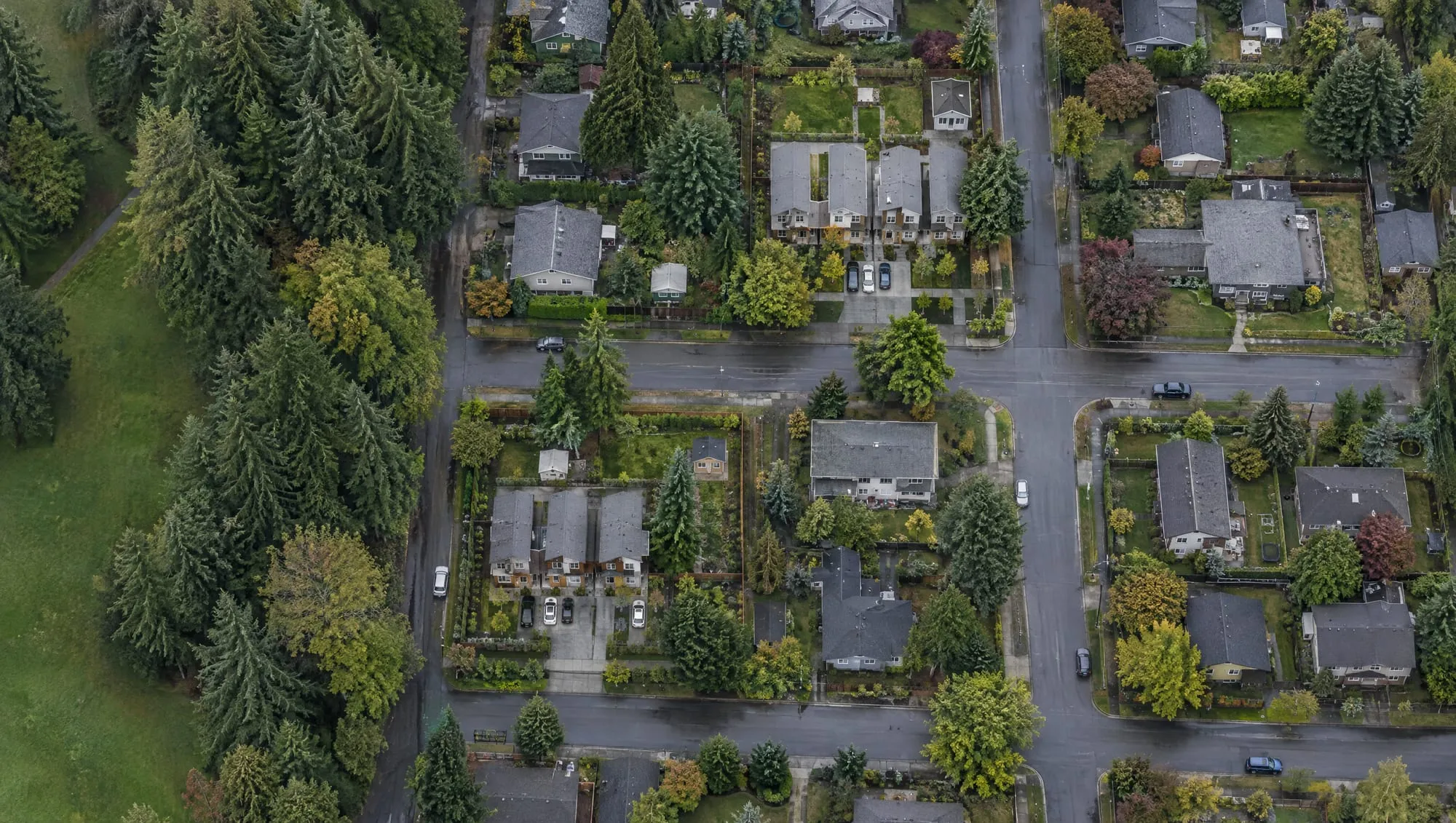
The default when a city misses its date. Commerce’s model ordinances, for cities of 25,000 and over ↗ and under 25,000 ↗, supersede conflicting local code until the city adopts its own. A user guide ↗ and a permit checklist for pre-empted jurisdictions ↗ go with them. For an appraiser, the municipal code on a city website can be out of date and still look authoritative. Mercer Island was still renewing interim HB 1110 and HB 1337 regulations in June 2026. Mercer Island Reporter ↗
Extensions and alternatives. Commerce administers four relief paths under WAC 365-199. WAC 365-199 ↗ An extension area is a parcel-level fact: a lot inside a certified extension area may still be limited to its pre-2025 density.
- WAC 365-199-060Substantially similar alternative action
- WAC 365-199-070Displacement-risk extensions
- WAC 365-199-080Infrastructure-capacity extensions
- WAC 365-199-090Empirical parking study certification (Marysville, June 2026, is the only one Commerce lists)
- Implemented new middle housing regulations84%
- Adopted a customized ordinance, not the model77%
- Allow unit lot subdivisions73%
- Cut parking requirements50%
- Allow zero lot line development48%
- Allowed higher densities than the statute (of those required)39%
- Allowed more housing types than the statute (of those required)24%
Eight jurisdictions not subject to HB 1110, including unincorporated King and Pierce counties, allowed middle housing voluntarily. PSRC HITS 2025 ↗ The 84% figure is a central Puget Sound survey result. Some secondary sources describe it as statewide, which it is not. Example ↗
A large city past the state floor
On a 5,000 sq ft Neighborhood Residential lot, 4 units by right and up to 12 with bonuses
Seattle adopted interim HB 1110 rules effective June 30, 2025, then replaced them with Council Bill 120993, Ordinance 127376, adopted Dec. 16, 2025 and effective Jan. 21, 2026. It repealed and replaced SMC Chapter 23.44, the first full rewrite of Neighborhood Residential zoning since 1982, and rezoned Residential Small Lot areas to LR1. One Seattle Plan ↗ The online SMC lagged the ordinance; SDCI posts consolidated NR and ADU code for reference. SDCI ↗
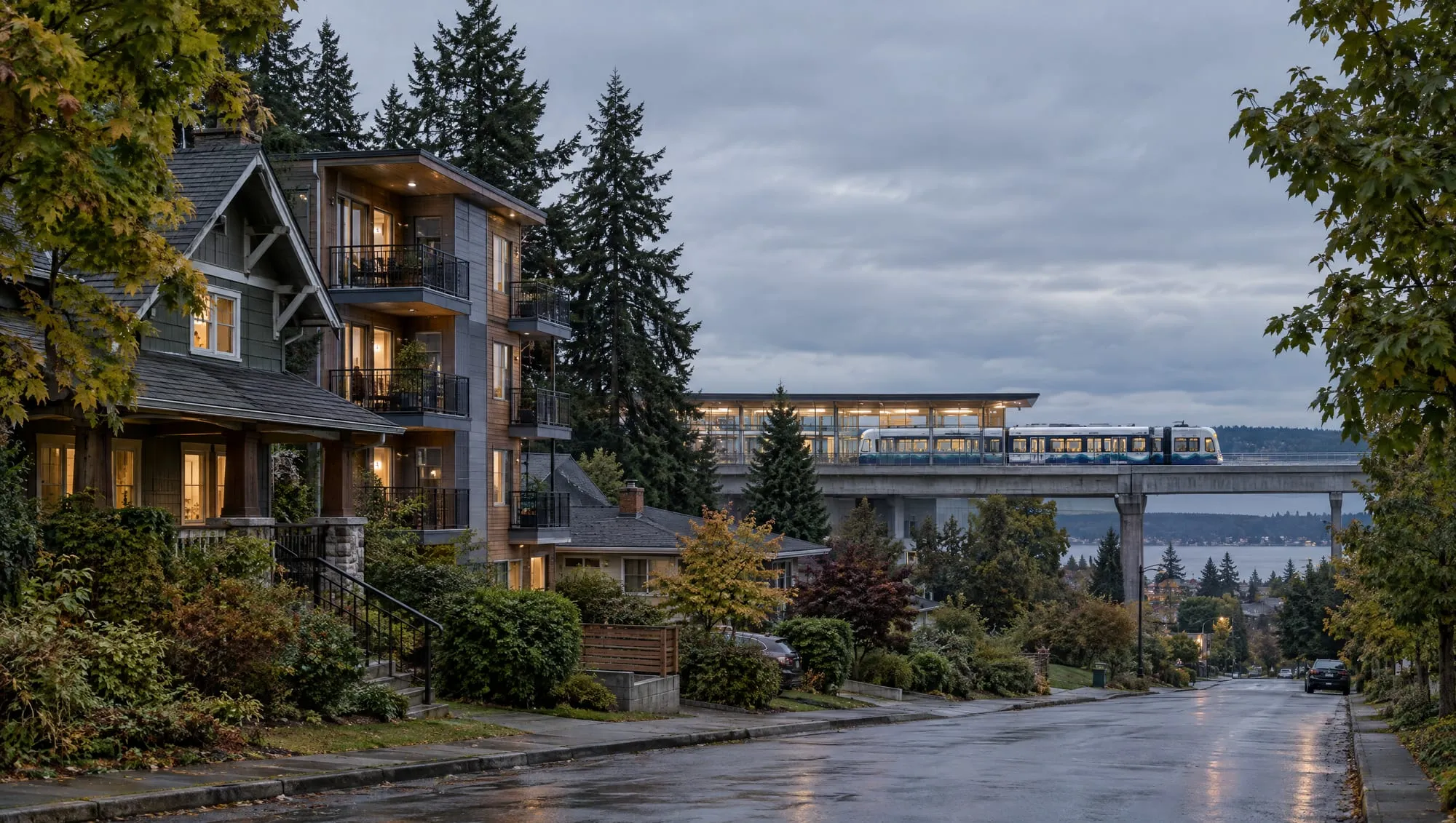
1Before HB 1110
One house plus ADUs. Neighborhood Residential allowed one principal house with accessory units.
4 units. The greater of 1 unit per 1,250 sq ft or 4 units. On 5,000 sq ft both give 4.
6 units. The state transit and affordability bonus, carried into the NR code.
8 units. 1 unit per 600 sq ft: 8 stacked flats, FAR 1.8, 60% coverage, 42 ft with Green Factor or trees.
12 units. 1 unit per 400 sq ft within 1/4 mile of frequent transit: 12 units and 4 stories.
| Standard | Base middle housing | Stacked flat bonus | Low-income bonus (1/4 mi of frequent transit) |
|---|---|---|---|
| Density | Greater of 1 unit per 1,250 sq ft, 4 units, or 6 near major transit or with 2 affordable | 1 unit per 600 sq ft | 1 unit per 400 sq ft |
| FAR | 0.6 to 1.6, scaled by density | 1.8; 2.0 with Green Factor or tree retention | 1.8 |
| Height | 32 ft; 42 ft with tree canopy credit | 42 ft with Green Factor or trees | 4 stories |
| Lot coverage | 50% | 60% | 60% |
| Parking | None within 1/2 mi of light rail, commuter rail or BRT, or for units of 1,200 sq ft or less; otherwise 1 space per 2 units; none for ADUs | Same | Same |
ADUs count toward density and may be up to 1,200 sq ft plus 250 sq ft of garage. New lots under 5,000 sq ft cannot be created; lot-split legislation required by HB 1096 is due in 2026. Limited corner-store commercial use is allowed on NR lots. Seattle compliance summary ↗ A separate Centers and Corridors bill transmitted in January 2026 would rezone about 30 new Neighborhood Centers for buildings up to six stories; check its adoption status for any NR parcel near a designated center. Centers and Corridors report ↗
We found no published permit counts for the permanent NR code, which has been in effect less than nine months. The city opened a call for pre-approved middle housing plans, from stacked duplexes to six-unit stacked forms, with submissions due July 2026. ADUniverse 2.0 guide ↗ Comparable sales of new NR stacked flats or unit-lot townhomes will be thin through at least 2027.
A mid-size city that rezoned before the mandate
Proposed units rose 62% in the first year; about 8% of those permits produced finished homes
Tacoma replaced all single-family zoning with three Urban Residential zones, UR-1, UR-2 and UR-3, under Amended Substitute Ordinance 28986, codified in TMC Chapter 13.06. Ordinance 28986 ↗ TMC 13.06 ↗ Four units are allowed on any lot, with more near transit and “complete neighborhood” features. Housing types are defined by building form: house-plex, backyard building, courtyard housing, rowhouse and multiplex. The minimum new parent lot for a unit lot subdivision is 2,500 sq ft. Zoning summary ↗
Two incentives create recorded title restrictions to look for. The ownership incentive grants development standard relief for homes sold to owner-occupants at or below 150% of Pierce County median income for at least 5 years, secured by a recorded title restriction. TMC 13.06.020.F.4 ↗ The affordability bonus adds density, height, size and MFTE for units at 60% to 80% AMI rental or up to 100% AMI ownership. Affordability summary ↗
- Permit applications213 +39%
- Units proposed385 +62%
Prior five-year average, implied by the city’s percentages
About 8% of first-year permits had produced finished units
- Applications
- 148
- Units proposed
- 332
- Units per application
- 2.2
- Still in review
- 140 of 148
Year one brought 39% more applications and 62% more proposed units than the prior five-year average, and 16% more units per application. In Q2 2026 activity shifted to the South End, Central and South Tacoma. Single-family and ADU applications were still the most common, though single-family applications hit a six-year low; townhomes, duplexes and multifamily produced the most units. City of Tacoma ↗ Q2 2026 update ↗ Year in Review ↗ Larger multifamily permits fell over the same period, and city staff attributed part of the pattern to interest rates and construction costs. The Urbanist ↗ Statewide permitting slowed in 2025. MBAKS ↗
An Eastern Washington city three years early
Middle housing reached 17% of Spokane’s permitted units in 2025, up from 3% to 4% in 2020 to 2022
Spokane passed the interim Building Opportunity and Choices for All ordinance in July 2022, allowing up to four units on single-family lots, and made it permanent as Building Opportunity for Housing in November 2023. The permanent code allows up to six units per lot in residential areas. Yahoo News ↗ Spokane Journal of Business ↗ Spokane County cities have a Dec. 31, 2026 state deadline, so the code will likely be revisited for HB 1110, HB 1337 and HB 1096 conformity.
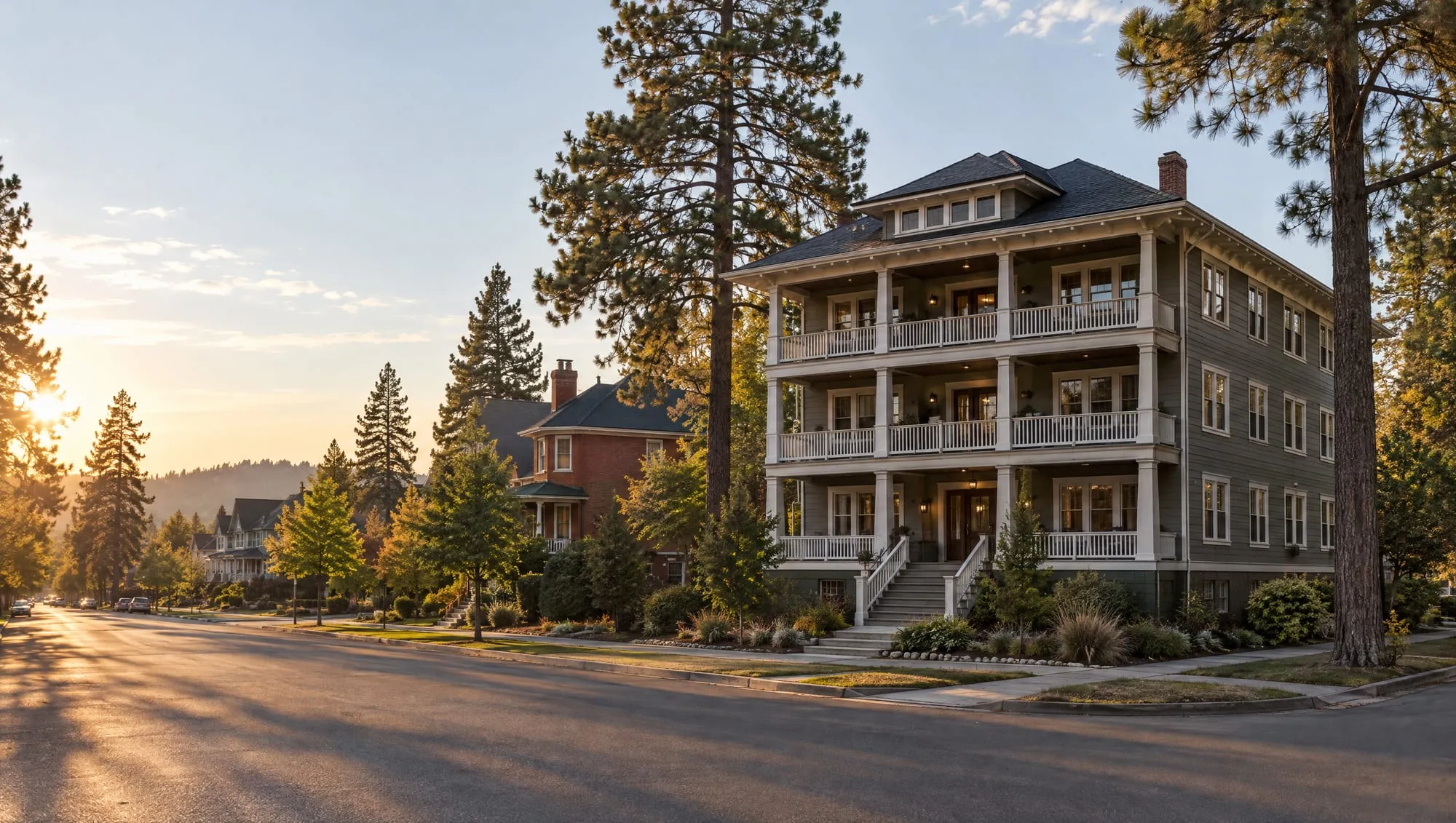
In 2024 the count reached 140 of 1,394 units, a 30-year high. The city’s analyst noted the share has not exceeded the earlier peaks and described the effect as stabilizing an underperforming segment. Townhomes of three to four units per lot are the dominant product; sixplexes remain rare. Spokane Journal of Business ↗ Inlander ↗
Two projects from the Spokane Journal: the Khinda Townhomes, 15 units on three lots at 3165 N. Stuart, and Cast Architecture’s Manito Six, six 1,000 sq ft two-bedroom flats on one stair at 1517 S. Grand Blvd. Cast’s founder noted that projects above five units move to commercial lending, commercial appraisals and separate underwriting, a financing break on the same lot size.
Other adopted codes to bookmark
- Renton
Adopted June 24, 2025. Up to four units per lot in RC, R-1, R-4, R-6 and R-8; six within 1/4 mile of a major transit stop. Renton ↗
- University Place
Ordinance 788, adopted June 2, 2025, with objective design standards. University Place ↗ Ordinance 788 ↗
- Mercer Island
Still under renewed interim HB 1110, HB 1337 and SB 5258 rules in mid-2026 while revising its plan after a Growth Management Hearings Board order on affordable housing capacity. Mercer Island Reporter ↗
- King, Pierce, Snohomish, Kitsap
Washington REALTORS keeps city-by-city ordinance links. Washington REALTORS ↗
Legal permissibility moved on a city-specific date
The legal use of most urban lots is now 2 to 6 units; feasibility still decides what the market pays
The legally permissible use of most urban residential lots in covered cities is now 2 to 6 units, and more in Seattle and Tacoma, effective on a city-specific date. That moves highest and best use, land value and zoning conformity.
Report the zone and the operative code version
Where a city is pre-empted, the model ordinance is the governing text even if the city website shows older code. Existing duplexes, triplexes and fourplexes that were legal nonconforming in single-family zones may now be legal conforming. Fannie Mae requires the appraisal to reflect any adverse effect of a nonconforming use on value and marketability; a reclassification to conforming removes that basis for an adjustment. B4-1.3-04 ↗
One unit with ADUs, or 2 to 4 units
Fannie Mae states an ADU should always be considered legal if current zoning allows it. B2-3-04 ↗ It classifies one unit with an ADU against 2 to 4 units by the property’s characteristics, including separate meters, a unique postal address and whether the unit can be legally rented, and leaves the call to the appraiser’s highest and best use analysis. B4-1.3-05 ↗ Washington ADUs can now be rented without owner occupancy and sold as condos, so a lot with two separately metered, addressed ADUs can read as a 3-unit property. Document the classification.
Lots that may not get the new density
Critical areas and buffers (only the affected portion after HB 2321), certified extension areas, the alternative-compliance 25%, septic-served areas (2 units until sewer) and areas with inadequate water. HB 1110 and HB 1337 bar new CC&Rs from prohibiting the added units but do not void existing ones, so a lot in an older subdivision with a single-family covenant may not be able to use the state allowance. Treat that as a title question in the legal test.
Highest and best use
Run the four tests against the new density. Physical possibility depends on lot width, access, slope, utilities and tree codes; financial feasibility on construction cost and exit pricing, which the Tacoma and Spokane data show is uneven.
An older small house on a large lot within 1/4 mile walk of a major transit stop is the profile where land value can approach or exceed value as improved. Fannie Mae requires the report to state when improvements clearly do not represent highest and best use; support it with a residual analysis or land sales. B4-1.3-04 ↗
Redevelopment takes capital, financing and an exit market, so most existing single-family homes will remain the highest and best use as improved for years.
Site and land value. Bracket land sales by the effective date of the buyer’s city code: a 2024 Seattle lot sale was priced under one-house-plus-ADU rules, a 2026 sale under 4 to 8 unit rules. Use units of comparison that reflect the entitlement, such as price per allowable unit or per buildable square foot (FAR times lot area), alongside price per lot. Transit proximity is now a legal attribute: measure walking distance to the stop type the statute names (light rail, commuter rail, qualifying BRT including BRT under construction), since a lot inside the 1/4 mile line can carry 50% more units in a city of 75,000 or more. Affordability covenants (50-year HB 1110 bonuses, Tacoma owner-occupancy restrictions, HB 1491 set-asides) run with title and reduce the market value of the restricted units, so read the recorded document.
| Product | Ownership form | What to confirm | Comp pool |
|---|---|---|---|
| Townhome on a unit lot | Fee simple unit lot; shared access and utility easements | Plat notes on nonconformity and future development limits (SB 5559 notice); maintenance agreement or small WUCIOA community | Other unit-lot townhomes |
| Stacked flat condo | Condominium under WUCIOA | Warranty form (implied, or HB 1403 / HB 2304 insured express warranty); reserve study status; project eligibility | Small condo projects; data is thin |
| ADU sold as condo | Condominium | Declaration, separate utilities, parking rights | ADU condos; rarely available |
| 2 to 4 unit rental | Fee simple, one parcel | Rent roll under the HB 1217 cap; 12-year new construction exemption | 2 to 4 unit sales; income approach |
| 5 to 6 unit building | Fee simple | Commercial lending and appraisal scope above 4 units | Small multifamily |
Sources: MRSC ↗ HCMP ↗ Spokane Journal of Business ↗ Expect a growing number of new 2 to 4 unit townhome and duplex sales on unit lots in Tacoma and Spokane, and few true stacked-flat condo resales anywhere yet. Commerce’s middle housing market assessment ↗ and pro forma tool ↗ document the state’s feasibility assumptions, which are useful for testing a residual land value.
HB 1217 rent cap
The yearly increase on an existing tenancy is capped at the lower of 7% plus CPI or 10%. New construction is exempt for 12 years, and the cap sunsets after 15 years. Washington State Standard ↗
Maximum yearly increase9.0%
7% plus CPI binds.
Rent growth assumptions in a DCF, or a GRM selection for older 2 to 4 unit properties, should reflect the cap. New middle housing may have zero to 0.5 off-street spaces per unit; where comps include garages or assigned parking, test for a market reaction to the difference.
For a Washington residential lot
Thirteen checks for appraisers, reviewers and collateral risk staff
0 of 13 checked
Your checks stay in this browser only.
Risks in construction and bridge lending
- 01
Entitlement and timing
Permits applied for are a weak signal of completion. In Tacoma about 8% of first-year permits produced finished units, and 140 of 148 Q2 2026 applications were still in review. City of Tacoma ↗
- 02
Exit liquidity
The as-complete value of a 4 to 8 unit infill project depends on whether units sell individually (unit lot or condo) or as a rental. Each exit has a different and currently thin comp set.
- 03
Infrastructure
Cities need not update capital facilities plans for the added density until their first plan update due on or after June 30, 2034. Water, sewer and stormwater capacity can block or delay an allowed project. Final Bill Report ↗
- 04
Feasibility
PSRC respondents named construction costs and market conditions as the top barrier to affordable production, and Tacoma staff saw larger projects slow in 2025 and 2026 while small infill held up. PSRC ↗ The Urbanist ↗
Dates and open questions
Middle housing, ADU and design rules due in Spokane, Benton, Franklin, Yakima and the other 2026 counties
Seattle lot-split legislation under HB 1096; Seattle Centers and Corridors rezone
SB 5184 parking caps due for cities of 50,000 and over (18 months after July 27, 2025)
Middle housing deadline for the 2027 counties
HB 1096 administrative lot split procedures due in most HB 1110 cities
SB 5184 parking caps due for cities of 30,000 to 50,000 (3 years)
HB 1491 TOD densities due in King, Pierce, Snohomish and Kitsap cities
Outcome of the 2025 referendum petitions on SB 5184 and HB 1491
Growth Management Hearings Board challenges to housing elements (Mercer Island, Port Townsend) and any later appellate rulings
Seattle permit and sales data under the permanent NR code
Hearings board sources: PAW case update ↗ Port Townsend ↗ Commerce also published an appraiser engagement FAQ ↗ in May 2024.
Appraising in a covered city?
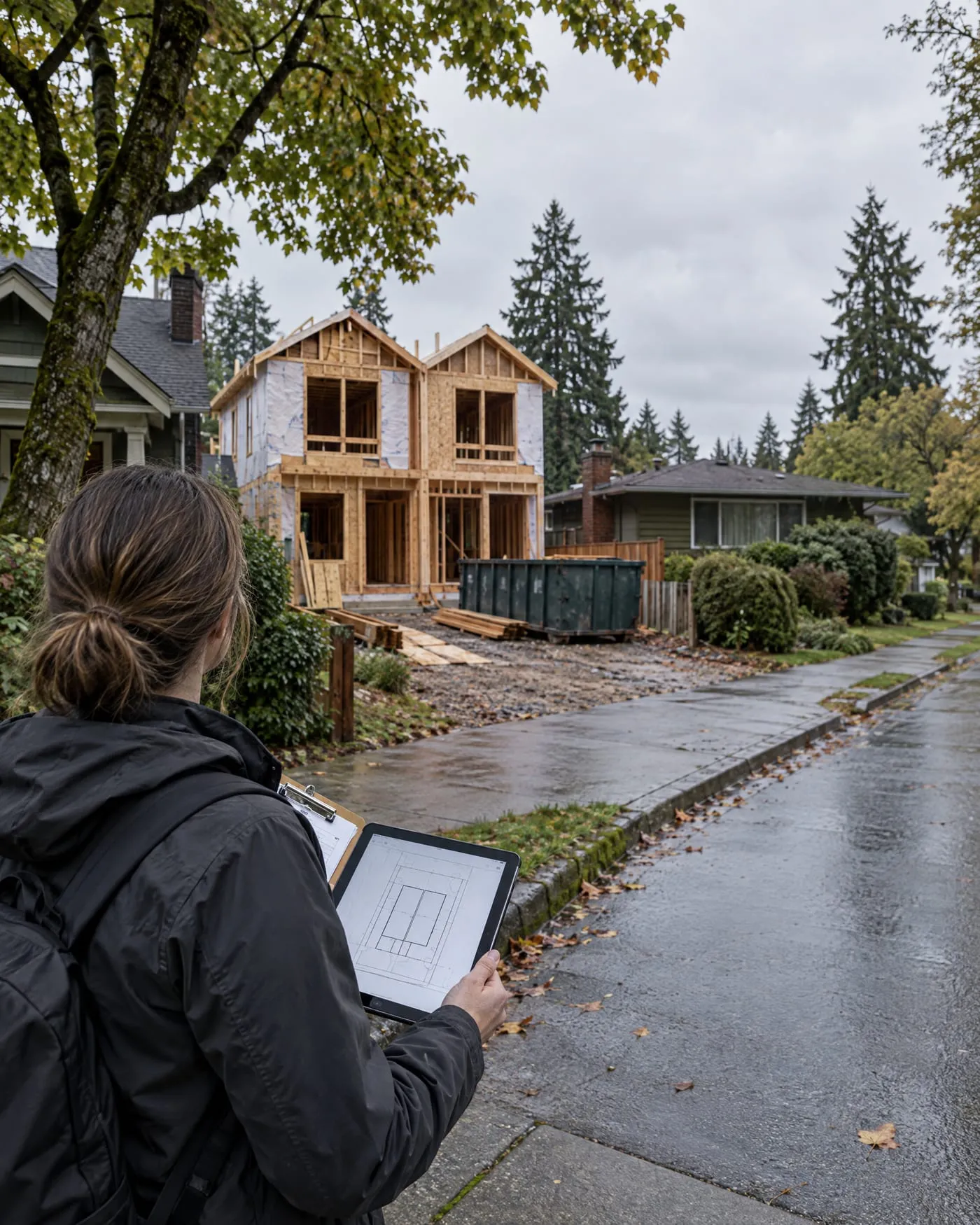
Valuing land or new middle housing in Washington?Tell us which comps you are using, how you bracket the code dates, and what reviewers have asked for.→Statuses are as of October 10, 2026. Code links point to the governing text; confirm current versions before relying on them in a report. Photographs in this article are AI-generated illustrations and do not show specific properties. This article is general information, not appraisal, legal or compliance advice.
The Signal / Monthly briefing
Follow zoning and appraisal policy changes, with sources.
One sourced briefing in the first week of each month.
Unsubscribe in one click. We don't sell your email or share it with sponsors. Privacy Policy